



Sustainable Furniture Certification Glossary — The Comosum Guide (2026)
The seven certifications that actually matter for sustainable furniture in 2026 are FSC, PEFC, GREENGUARD Gold, B Corp, OEKO-TEX Standard 100, ISO 14001, and the Sustainable Furnishings Council Gold Exemplary rating. This guide explains what each one measures, which Comosum brands carry it, and how they feed the Comosum Sustainability Meter — the six-category rubric we use to grade every brand we carry. Use this as the index. Each certification has a dedicated explainer page linked below.
Certifications matter in furniture because the alternative is a marketing line. "Sustainable wood" with no certificate is unverifiable. "Low-VOC finish" without a chamber test result is a slogan. "Ethical manufacturing" without a third-party audit is a brand telling its own story. The seven certifications below convert vague claims into verifiable facts — each is administered by an independent body, has a public lookup, and requires renewal on a schedule. We use them in combination because no single certificate measures everything that matters: forest source, finish chemistry, factory practice, textile safety, and company-level governance are five different audits. Trust, but verify.
The 7 certifications, in one paragraph each
FSC (Forest Stewardship Council)
FSC is an international chain-of-custody standard for wood and wood-based products, administered by the Forest Stewardship Council since 1993. The certificate traces timber from a responsibly managed forest through every processing step — sawmill, panel maker, factory, distributor — to the finished piece of furniture, with every link in the chain audited annually by accredited third-party certifiers. FSC labels appear in three tiers: FSC 100% (every fiber from FSC-certified forests), FSC Mix (at least 70% FSC-certified or recycled content), and FSC Recycled (post-consumer recycled wood). Comosum brands holding FSC include Ethnicraft (teak, on select indoor lines) and FDB Møbler (oak). Cane-Line's teak is SVLK-verified, under Indonesia's national timber-legality system. Read the full FSC explainer.
PEFC (Programme for the Endorsement of Forest Certification)
PEFC is the European-led counterpart to FSC, founded in 1999 as an umbrella for national forest standards. The certification model is functionally equivalent to FSC — chain-of-custody audits from forest to finished product — with broader coverage of smallholder forests in Europe and a different governance structure. PEFC and FSC are scored equivalently in the Comosum Sustainability Meter. Among Comosum brands, Tiptoe is the named PEFC holder (certificate PEFC/07-31-60) for the European oak across its tables, desks, and shelving range. PEFC is covered in detail within the FSC explainer, as the two systems are best understood side by side.
GREENGUARD Gold
GREENGUARD Gold is the stricter tier of UL Solutions' indoor-emissions certification for finished products, capping formaldehyde at 7.3 parts per billion and total VOCs at 220 micrograms per cubic meter — the thresholds set for California schools and US healthcare facilities. Testing happens in a UL environmental chamber. The certificate is publicly searchable at spot.ul.com, and certified products stay under routine testing. To check a claim, look up the exact model in SPOT: a brand-wide statement is not a certificate for the piece you are buying. Read the full GREENGUARD Gold explainer.
B Corp (Certified B Corporation)
B Corp is a company-level certification administered by the nonprofit B Lab that scores a business across five impact areas — Governance, Workers, Community, Environment, and Customers — and requires a minimum of 80 points out of 200 to certify. Certified B Corps must amend their legal governing documents to embed stakeholder accountability. Recertification happens every three years. Comosum brands holding B Corp independently include Anglepoise, Tala, Tiptoe, and Humanscale. The Rosendahl Design Group holds B Corp at the group level, covering Kähler, Holmegaard, Lyngby Porcelæn, and the Rosendahl own-label. Read the full B Corp explainer.
OEKO-TEX Standard 100
OEKO-TEX Standard 100 is a textile safety certification administered by the International OEKO-TEX Association since 1992 that tests every component of a fabric — thread, dye, print, button, zipper, trim — against more than 1,000 harmful substances and confirms the material is safe for direct skin contact. Certificates are issued for one year and renewed annually. Products are classified into four classes by intended use, with Class I (baby and infant articles up to age 3) the strictest. Among Comosum brands, OEKO-TEX is most often a mill-level certification inherited by the furniture brand at the SKU level — particularly on upholstery options for Cane-Line and Mater. Read the full OEKO-TEX explainer.
ISO 14001
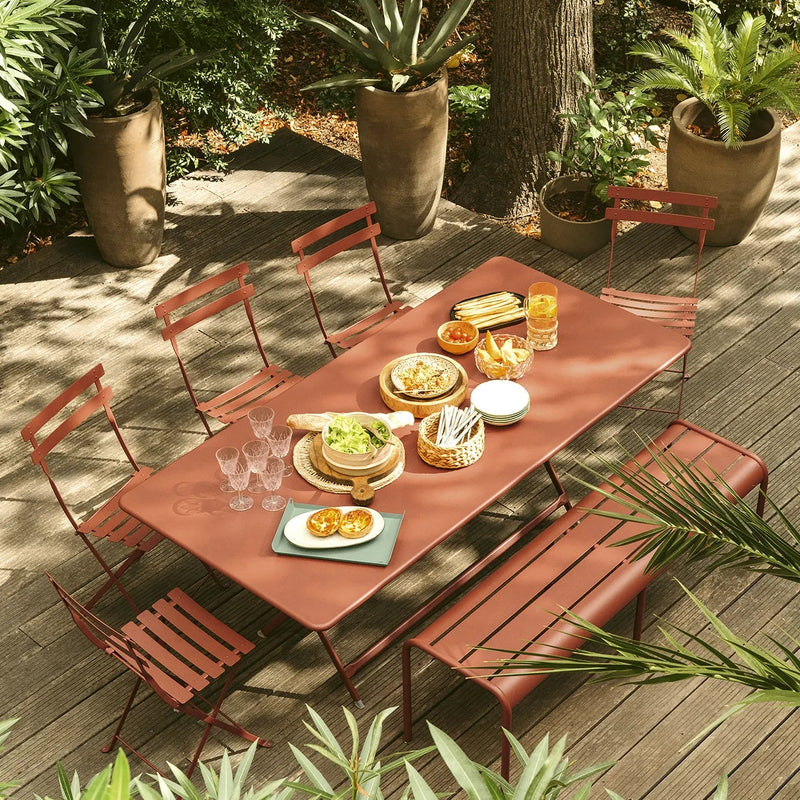
ISO 14001 is the international standard for environmental management systems, administered by the International Organization for Standardization since 1996. The certification audits a manufacturing facility's documented system for managing waste, energy, water, and emissions, with annual surveillance audits and full recertification every three years. ISO 14001 does not set numerical thresholds; it audits whether the facility has a working system that delivers continuous improvement. Among Comosum brands, Fermob has held ISO 14001 since March 2010 across its three French manufacturing sites (Thoissey, Anneyron, Mâcon), and Greenington manufactures in ISO 14001 certified facilities. Read the full ISO 14001 + SFC Gold explainer.
SFC Gold (Sustainable Furnishings Council Exemplary)
The Sustainable Furnishings Council is a US-based industry association that operates a multi-tier rating system for furniture brands across material sourcing, manufacturing, energy, transparency, and chain-of-custody commitments. SFC Exemplary is the top recognition tier; within Exemplary the levels are Silver, Gold, and Platinum. SFC Gold Exemplary is awarded to a very small set of brands worldwide. Among Comosum brands, Fermob has held SFC Gold Exemplary since 2017, as one of only four manufacturers worldwide to hold the Gold Exemplary tier. Read about it in the ISO 14001 + SFC Gold explainer.
Quick comparison table
| Certification | What it measures | Who administers | Comosum brands carrying it | Read more |
|---|---|---|---|---|
| FSC | Wood source — forest to finished product | Forest Stewardship Council (Bonn) | Ethnicraft (select teak lines), FDB Møbler | FSC explained |
| PEFC | Wood source — European-led alternative to FSC | Programme for the Endorsement of Forest Certification | Tiptoe (PEFC/07-31-60) | Covered in FSC explainer |
| GREENGUARD Gold | Finished-product VOC and formaldehyde emissions | UL Solutions | Check the model in UL's SPOT directory | GREENGUARD Gold explained |
| B Corp | Company-level practice across 5 impact areas | B Lab (nonprofit, Berwyn PA) | Anglepoise, Tala, Tiptoe, Humanscale; Rosendahl Design Group (Kähler, Holmegaard, Lyngby Porcelæn, Rosendahl) | B Corp explained |
| OEKO-TEX Standard 100 | Textile safety — 1,000+ harmful substances | International OEKO-TEX Association (Zurich) | Cane-Line upholstery, Mater upholstery (at mill level) | OEKO-TEX explained |
| ISO 14001 | Factory environmental management system | International Organization for Standardization | Fermob (since 2010), Greenington (factory level) | ISO 14001 explained |
| SFC Gold Exemplary | Furniture-industry brand rating, top tier | Sustainable Furnishings Council (US) | Fermob (since 2017) | SFC Gold explained |
How to read a sustainable furniture spec sheet
A credible sustainability claim has a certificate number behind it. An unverifiable claim does not. Here is the practical pattern we apply when evaluating a brand or product:
Look for the certificate name and number, not the buzzword. "FSC Mix, certificate FSC-C012345" is real. "Sustainable wood" or "responsibly sourced" with no certificate is marketing. The certificate number is publicly searchable in a database, and any brand confident in its claim will produce it on request.
Match the certificate to the question. FSC is the wood question. GREENGUARD Gold is the finish-chemistry question. OEKO-TEX is the textile question. B Corp is the company question. ISO 14001 is the factory question. A brand that holds one is making one claim — not a blanket sustainability claim.
Check the renewal date. Every certificate has a validity period. FSC chain-of-custody is annually surveilled, OEKO-TEX is renewed annually, B Corp is renewed every three years, ISO 14001 is renewed every three years. A lapsed certificate is not a valid current claim.
Be skeptical of "eco-friendly," "natural," "green," and "non-toxic" used alone. Those words have no fixed definitions. The certification system exists precisely because the words do not. If a brand uses those words, ask which certificate backs them.
Country of origin is not a certification. "Made in Italy" is a manufacturing-location label, not a sustainability claim. Italian factories can be ISO 14001 certified or not; the country alone does not tell you.
Where these certifications sit in the Comosum Sustainability Meter
The Comosum Sustainability Meter is our six-category scoring rubric — Material, Transportation, Manufacturing, Labor, Energy and Durability — and it scores brands, not single products: every product shows its brand's scores. Here is where each certification counts:
- FSC and PEFC count under Material: a brand scores 5 when most of its range is certified, and 4 when certified content covers part of it.
- GREENGUARD Gold tests the emissions of a single product. We name it on product pages where a brand holds it, but it doesn't measure any of the six categories, so it doesn't change a Meter score.
- B Corp counts under Labor, where it scores 5 when the B Lab listing names the brand, and under Manufacturing, where it scores 4.
- OEKO-TEX Standard 100 tests the chemistry of a single textile product. Like GREENGUARD Gold, we name it where a brand holds it, but it doesn't change a Meter score.
- ISO 14001 counts under Manufacturing: it earns a 4 when it covers most of the range, and a 5 with a published, verified figure.
- SFC Gold Exemplary isn't among the certificates the methodology lists as proof. We name it where a brand holds it.
No certificate earns a 30 of 30 on its own. The certifications above speak to Material, Manufacturing and Labor; Transportation, Energy and Durability need their own evidence, such as where a brand makes things, published energy figures, warranties and spare parts. To be carried, a brand still has to clear the Meter's three rules: no category at 1, a grade of at least 3.0 (18 of 30), and no more than two categories below 3.
Frequently asked questions
Which certification matters most for sustainable furniture?
There is no single answer. The certifications cover different questions. For solid-wood case goods, FSC is the most load-bearing. For finished-product air quality, GREENGUARD Gold. For company-level practice, B Corp. For textiles, OEKO-TEX. For factory environmental management, ISO 14001. A piece that carries the relevant certificate for its category, plus B Corp at the company level, is fully audited.
Which Comosum brands carry the most certifications?
Fermob (ISO 14001 since 2010, SFC Gold Exemplary since 2017) and Greenington (solid Moso bamboo from an ISO 14001-certified factory) are the strongest stacks at the brand-and-product level. Among the B Corp brands, Tiptoe (B Corp since October 2022, PEFC/07-31-60 wood) and the Rosendahl Design Group (B Corp at parent level, covering four brands) are the broadest combinations.
What's the difference between FSC and PEFC?
Both are credible third-party forest certifications using the same chain-of-custody approach. FSC was founded in 1993 by a coalition of environmental groups and industry; PEFC in 1999 as an umbrella for national forest standards. FSC has historically had broader environmental NGO support; PEFC has broader smallholder-forest coverage in Europe. The Comosum Sustainability Meter scores them equivalently. Most North American buyers will encounter FSC more often than PEFC.
Are there any certifications we should be skeptical of?
Self-administered or industry-only certifications without a third-party audit step are weaker than the seven above. So are certifications that lack a public certificate database (because verification is impossible). And so are "carbon neutral" or "climate positive" claims based on offset purchases rather than actual emissions reductions — the certifications above audit the underlying practice; offsets are downstream of that.
How do I know if a brand's claim is current?
Look up the certificate in the relevant public database. FSC at info.fsc.org. OEKO-TEX at oeko-tex.com. B Corp at bcorporation.net. GREENGUARD Gold at spot.ul.com. SFC at sustainablefurnishings.org. ISO 14001 certificates are usually verified by asking the brand for a copy and cross-checking with the issuing certification body.
Why doesn't Comosum require every brand to hold every certification?
Because that would be the wrong filter. The certifications cover different categories. A brand making solid-wood case goods does not need OEKO-TEX. A brand making bamboo case goods does not need FSC. The Comosum Sustainability Meter counts each certificate under the category it measures, and a brand must still clear three rules to be carried: no category at 1, a grade of at least 3.0 (18 of 30), and no more than two categories below 3. Requiring every cert on every brand would push us toward a smaller and less interesting catalog.
Is there a certification for end-of-life recyclability or take-back programs?
Cradle to Cradle Certified is the closest — it covers material health, product circularity, renewable energy, water stewardship, and social fairness, on a tier system. C2C is the most ambitious published rubric for furniture but it is product-by-product and brand-applied-for, which limits coverage in practice. Among the brands we carry, several offer take-back or repair programs (Ethnicraft's Re-Loved program, Anglepoise's lifetime guarantee on new lamps) without going through C2C specifically. The Comosum Sustainability Meter counts these signals under Durability: a lifetime or five-year-plus warranty and a spare-parts, repair or buy-back service are two of its four signals.
How often does this glossary get updated?
Whenever a brand we carry gains or loses a certificate, or a standard changes. If you spot an error, email hello@comosum.co and we'll correct it.
Browse the full Comosum catalog — every product in it comes from a brand graded on the Sustainability Meter. Filter by brand on the sustainable furniture brands pillar guide. Read the full Sustainability Meter methodology for how the certifications above feed a brand's six scores.
Proud Member of Be Original Americas
Comosum is also a proud member and advocate of Be Original Americas, the leading organization dedicated to supporting and protecting original design. Be Original Americas promotes the economic, ethical, and environmental value of authentic design, encouraging both creators and consumers to understand why originality matters. Through our membership, we stand alongside a global community that values creativity, innovation, and craftsmanship.
Being part of Be Original Americas reinforces our belief that great design should respect its creators and the planet. It’s a commitment to authenticity — ensuring that every piece we offer honors the artistry, sustainability, and integrity that define original design.
Proud Member of Be Original Americas
Comosum is also a proud member and advocate of Be Original Americas, the leading organization dedicated to supporting and protecting original design. Be Original Americas promotes the economic, ethical, and environmental value of authentic design, encouraging both creators and consumers to understand why originality matters. Through our membership, we stand alongside a global community that values creativity, innovation, and craftsmanship.
Being part of Be Original Americas reinforces our belief that great design should respect its creators and the planet. It’s a commitment to authenticity — ensuring that every piece we offer honors the artistry, sustainability, and integrity that define original design.

 🔒 Secure checkout
30-Day Returns
Warranty Included
🔒 Secure checkout
30-Day Returns
Warranty Included