
Sustainable Outdoor Furniture from French, Danish, and Spanish Brands
The sustainable outdoor furniture brands worth buying in the United States in 2026 are Cane-line (Denmark), Fermob (France), Isimar (Spain), Resol (Spain), Tiptoe (France), and Heller (United States). Five of the six ship from Comosum's US warehouse. The sixth, Isimar, ships direct from Spain on a four-to-six-week lead time — the only outdoor brand in our catalog without US stock.
The most sustainable patio set is the one you keep for twenty years.
Most outdoor furniture sold in America lasts about five summers. Joints fail. Powder finishes chalk. Recycled-content plastic — done right — outlives the building it sits beside. This guide is about the brands engineered for the long version of that story, and how to pick one for the specific patio, rooftop, or garden you are furnishing.
What this guide covers
- The six brands, where they're made, and what each one is best at
- Outdoor-specific materials: FSC teak, powder-coated steel, recycled polypropylene, marine-grade galvanization
- How to choose by US climate (Mediterranean, Pacific Northwest, coastal salt-spray, freeze-thaw Northeast)
- Winter, UV fade, and the durability question
- Eight FAQs and where to go next
For broader brand context — non-outdoor catalogs, indoor wood specialists, lighting houses — see our European brands directory. For the scoring framework that grades every product page, see the Comosum Sustainability Meter.
How we evaluated outdoor sustainability
Three criteria. Each is stricter than the indoor version of the question.
A material chain you can audit
An outdoor brand that talks about "weather-resistant materials" without naming a certificate is selling a marketing line, not a piece of furniture. We look for FSC chain-of-custody on teak, ISO 14001 audits on powder-coating lines, and post-consumer percentages on recycled plastic — published at the SKU level.
Built for weather, not photographed for weather
Outdoor furniture lives through UV, salt spray, and freeze-thaw cycles north of the Mason-Dixon line. The brands here publish UV-stability data, marine-grade finishes, and frost ratings. Not in the brochure. In the spec sheet.
US availability through a single retailer
Five of the six brands here ship from our US warehouse on standard domestic freight. Outdoor projects often run on tight install calendars; Spain-to-Atlantic ocean freight is not interchangeable with US-warehouse stock. We flag the one exception (Isimar) clearly so designers can plan around it.
The six brands, by country
Denmark — Cane-line
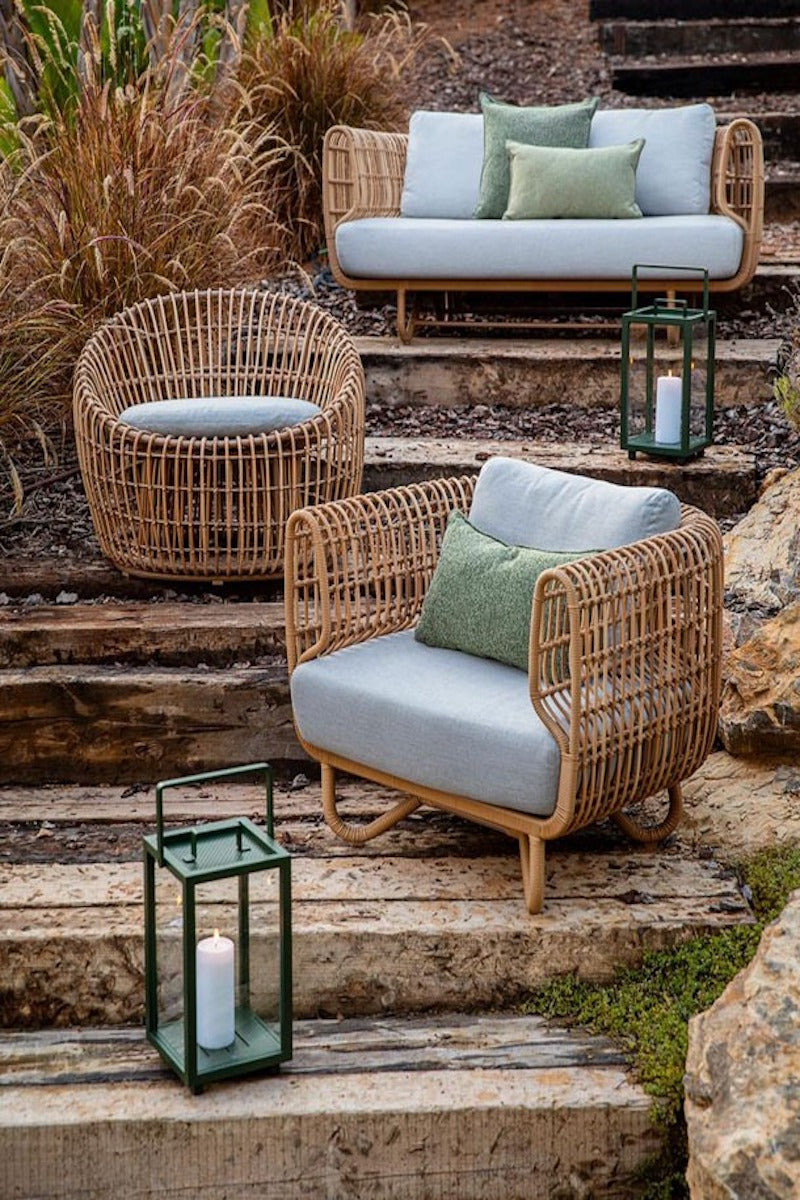
Cane-line is the Danish house built for outdoor living, and the deepest single outdoor brand in our US warehouse at roughly 147 SKUs in active rotation. The company was founded in 1986 and is still family-owned; CEO Brian Djernes has run it since 1997, the year the catalog expanded from indoor to outdoor. Headquarters sits in Rynkeby on the island of Funen, with US stock held in Comosum's warehouse for domestic freight.
The materials story is unusually complete for the category:
- FSC-certified teak across the teak range, with chain-of-custody back to the forest
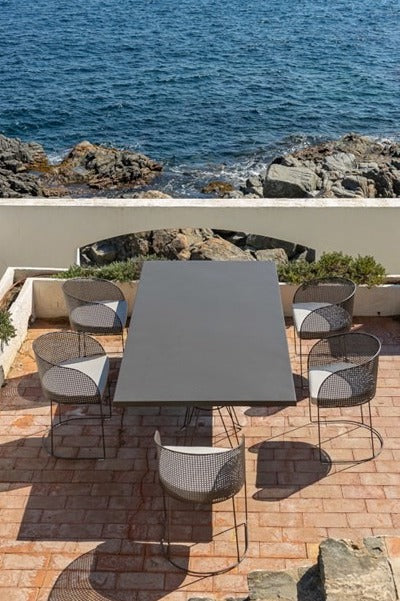
- Cane-line Soft Rope — a UV-resistant polypropylene rope, recyclable, that does not fade in direct sun
- Cane-line Fibre — a woven composite with recycled content, used in the rope-look catalog
- Powder-coated aluminum frames, light enough to move and immune to rust
Cane-line designs for material separation: a lounge chair can be disassembled at end of life into its teak, its aluminum, its rope, and its textile, with each stream recyclable in its own right. The brand uses the language "made with recyclable materials" rather than a single recyclability percentage — accurate, and stronger than the industry default of saying nothing at all.
Cane-line anchors our outdoor lounge, outdoor chairs, and outdoor dining ranges. For the Scandinavian design lineage behind the brand, see our Scandinavian sustainable design guide.
France — Fermob and Tiptoe
Fermob is the canonical European outdoor brand and holds the deepest paper trail in the category. The company traces back to an 1890 blacksmith's workshop in Thoissey, France; outdoor furniture production began in 1953; the modern Fermob took shape in 1989 when Bernard Reybier acquired the company and rebuilt the strategy around color and design. Three manufacturing sites still operate in France — Thoissey (the historic site), Anneyron in the Drôme (aluminum and painting), and Mâcon (cushions, via the Vlaemynck subsidiary).
The sustainability paper trail:
- ISO 14001 environmental management certification since March 2010, renewed annually
- Sustainable Furnishings Council Gold (Exemplary) recognition since 2017 — Fermob was the fourth manufacturer worldwide to earn this tier
- Solvent-free powder paints, applied in a zero-waste facility
- Steel and aluminum construction, materials with the highest recycling rates in the metals industry
Three pieces define the brand. The Bistro folding chair is built from Edouard Leclerc's 1889 "Simplex" patent — the chair that filled Parisian café terraces the same year the Eiffel Tower opened — and Fermob still produces it from the original silhouette in a palette of 25 colors. The Luxembourg collection is the chair specified for the Jardin du Luxembourg in Paris, made by Fermob for the Sénat and sold to the public in the same construction. The Balad portable lamp is the brand's modern signature in outdoor lighting: a rechargeable LED that moves from table to terrace to bedside.
Tiptoe (founded 2015) is the newest French house in our catalog and a B Corp since 2021. The outdoor entry is the MIDI SSDr chair in recycled polypropylene — stackable, contract-grade, designed for the kind of hospitality use that destroys cheap plastic chairs within a season.
Spain — Isimar and Resol
Isimar is the Spanish outdoor specialist working in galvanized and powder-coated steel. The company was founded in 1964 as Industrias San Isidro Murillo, a metal-rod manufacturer; it shifted strategy toward furniture design in 2010 and launched the iSiMAR brand in 2012. Production sits in Noáin, Navarra, in northern Spain, with more than fifty years of accumulated metal-industry expertise behind the welding and finishing.
Isimar is the one brand in this guide that does not ship from our US warehouse — pieces leave Spain on a typical four-to-six-week lead time for production and ocean freight. We carry the brand because the catalog fills a specification gap our US-warehoused brands don't cover: marine-grade galvanized steel with a powder-coat overcoat, built to commercial outdoor specifications at a residential price point.
The engineering signature is the double-protected substrate. Hot-dip galvanization bonds zinc to the steel before any topcoat goes on; the powder coat then finishes over the zinc. The result survives salt-spray environments — coastal installations, rooftop bars within sight of the Atlantic — that strip ordinary powder-coated steel inside a few summers.
Resol was established in 1964 in Girona, on Spain's Mediterranean coast, and was one of the first Spanish manufacturers to use injection-molded plastic in furniture. Production runs out of a 40,000 m² facility in Les Preses, Girona; the brand has sold more than fifty million chairs across one hundred and ten countries. Resol's Green Edition range is manufactured from post-consumer recycled polypropylene — the stated company goal is to eliminate virgin plastic from the factories entirely.
Resol sits in the value end of the outdoor catalog. Specify it for restaurant terraces, event seating, and rooftop installations that need to stack and clean down quickly.
United States — Heller
Heller (founded 1971, Hauppauge, New York) is the American counterpoint in this guide. Heller manufactures in New York using recycled and recyclable polyethylene, runs a closed-loop take-back program, and holds a designer roster — Mario Bellini, Frank Gehry, Vico Magistretti, Massimo Vignelli — that puts the brand in museum collections across the country.
The outdoor offering centers on benches in roto-molded polyethylene by Frank Gehry, sized for public-realm and residential garden use. The Bellini chair (originally a 1998 design that won the Compasso d'Oro in 2001) is the indoor signature, but the polyethylene material is engineered for indoor-outdoor use across the catalog. Heller is the brand to specify when a project brief calls for a named American designer in recycled material — and the only brand here producing on US soil.
For the broader story on Heller's mid-century reissue program — Bellini, Gehry, Vignelli — see our mid-century reissues guide.
Outdoor materials guide
Outdoor materials are the load-bearing decision. Pick the right one for your climate and the rest of the spec follows.
FSC-certified teak
The strongest single signal in sustainable outdoor wood. The Forest Stewardship Council audits the chain from plantation to finished product. A brand with FSC certificates on its teak can demonstrate that the wood was harvested from a managed forest — replanted, biodiversity-controlled — rather than from old-growth deforestation.
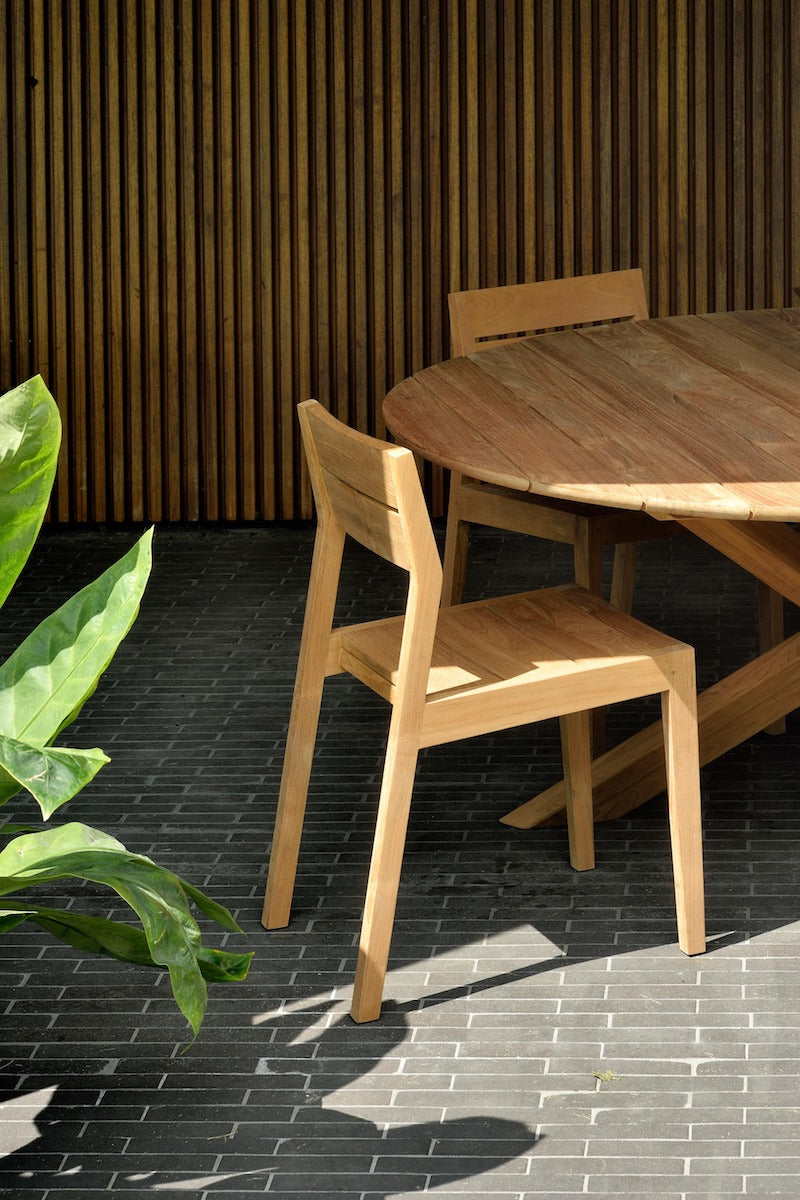
Cane-line operates its teak supply on FSC chain-of-custody. Teak's natural oils make it the longest-lived hardwood outdoors; properly specified FSC teak ages to a silver patina and lasts thirty to fifty years on a covered terrace. The certification is what tells you the next generation of that forest still exists.
Powder-coated steel (ISO 14001 process)
The most repairable outdoor finish on the market. Powder bonds electrostatically to the steel substrate and resists chipping; a damaged piece can be stripped and re-coated rather than scrapped.
Fermob's ISO 14001 certification covers the powder-coating process specifically — solvents, off-gas capture, waste streams, audited annually. A Fermob Bistro chair that fades after twenty New England winters can be re-coated in a new color. The steel underneath is still good. Compare to a virgin-plastic chair that has to be landfilled when the color goes.
Recycled polypropylene and polyethylene
Recycled-content plastic furniture is the category most prone to greenwashing — and the one with the largest sustainability upside when it's done right.
- Recycled polypropylene — Resol's Green Edition range, Tiptoe's MIDI chair. Stackable, dishwasher-cleanable, contract-grade.
- Recycled polyethylene (roto-molded) — Heller's Gehry benches. Mass-pigmented (the color is in the material, not on top), engineered for public-realm life.
- Cane-line Soft Rope — UV-stable polypropylene rope, recyclable at end of life.
Conventional outdoor plastic furniture is virgin polypropylene that crumbles into microplastic within five summers. Recycled-content plastic from these brands is engineered for UV stability and structural load — and the feedstock has already lived one lifecycle rather than being newly extracted from petroleum.
Marine-grade galvanized steel
The specification for coastal and salt-exposed installations. Hot-dip galvanization bonds zinc to the steel at the molecular level before any topcoat is applied. Ordinary powder-coated steel rusts from the inside out when salt spray penetrates the powder finish — usually starting at fastener points. Galvanized substrate prevents that.
Isimar uses this construction across the outdoor catalog. It's why marine and coastal specifiers ask for the brand by name.
A sanity check for any product page
Count how many material terms appear with a number, a mill, or a certificate.
A page that names "FSC teak with marine-grade stainless fasteners" tells you something. A page that says "weather-resistant materials" tells you nothing.
How to choose outdoor furniture by climate
The right material in the wrong climate is the wrong material. Here is the practical breakdown for the four US climate zones we get asked about most often.
Hot and dry — Mediterranean climates (Southern California, Arizona, parts of Texas)
The risk is UV fade and surface heat. Steel and aluminum get hot enough to burn skin in full Arizona sun; light-colored plastics chalk and fade.
- Best: FSC teak (the silver patina is the point), Cane-line Soft Rope in mid-tone colors, Fermob in darker colorways
- Consider: outdoor accessories — shade structures and cushions are doing the real work in this climate
- Avoid: Light-colored recycled-polypropylene chairs in full sun for ten hours a day. Stackable plastics belong on covered terraces here.
Cold and wet — Pacific Northwest (Seattle, Portland, coastal Oregon)
The risk is moisture penetration and mildew on textiles. Freeze-thaw is mild but persistent.
- Best: Fermob powder-coated steel (handles the constant wet), Cane-line teak that wants to silver, Heller polyethylene benches (plastic does not absorb water)
- Care: Pull textile cushions inside between uses; the frames are fine year-round
- Avoid: Cushions stored outside on a deck. The fabric will outlive the foam, and the foam goes first.
Coastal salt-spray — anywhere within a mile of the ocean
The risk is rust from below. Standard powder-coated steel fails inside-out within three to five years of coastal service.
- Best: Isimar marine-grade galvanized steel (this is what the engineering is for), Cane-line aluminum frames (does not rust at all), Heller polyethylene
- Lead time note: Isimar ships from Spain on a four-to-six-week lead time. Plan for it.
- Avoid: Standard powder-coated steel from any brand for direct salt-spray installations.
Freeze-thaw — Northeast, Midwest, Mountain West
The risk is water penetration and expansion-contraction damage. Powder-coated steel handles this beautifully. So does teak. So does plastic.
- Best: Fermob powder-coated steel (the Bistro chair has a century of documented service in this kind of climate), Cane-line FSC teak (ages to silver, does not crack), Heller benches (year-round in public installations across the Northeast)
- Care: A winter cover extends the powder-coat color life but is not required for survival
- Avoid: Anything you would not want to leave out from November through March. Buy fewer pieces engineered for the weather rather than more pieces engineered for the brochure.
Winter and weather — the durability question
The single most-asked question in sustainable outdoor furniture: does it survive a real winter? The answer depends on the material, not the brand.
- Powder-coated steel (Fermob, Isimar) — Handles freeze-thaw without cracking. The steel substrate doesn't expand or contract with water; the powder finish flexes with temperature swings. Year-round outside, Boston to Minneapolis, no cover required.
- FSC teak (Cane-line) — Natural oils repel water and resist rot. The silver patina is a finish, not a degradation. Pull cushions inside; leave the frames out.
- Recycled polypropylene and polyethylene (Resol, Tiptoe, Heller) — Plastic does not absorb water. UV is the longer-term concern. A covered winter extends color life on the lighter-colored pieces.
- Marine-grade galvanized steel (Isimar) — The specification for coastal installations. Zinc layer beneath the powder coat prevents the inside-out rust that defeats ordinary outdoor steel within three to five years of coastal service.
- UV fade — The slowest failure mode. Steel and teak handle full Arizona sun best; for extreme exposure, avoid lighter-colored plastics in unshaded installations.
How to choose
The shortest version of this guide:
- For a Parisian café set — Fermob Bistro. The 1889 design, the colour palette, the powder-coated steel that lives through winter without storage.
- For FSC teak that ages to silver — Cane-line. Documented chain-of-custody, designed for material separation at end of life, the patina specifiers actually want.
- For commercial-grade marine steel — Isimar. Plan for the four-to-six-week Spain ship.
- For recycled plastic content — Resol Green Edition for contract-grade stacking, or Tiptoe MIDI for the design-led version.
- For a US-made brand — Heller. Gehry and Bellini in recycled polyethylene, made in New York, closed-loop take-back.
- For everything in one warehouse — Cane-line and Fermob between them cover outdoor chairs, outdoor lounge, outdoor dining tables, and outdoor lighting, all from US stock.
Frequently asked questions
Which sustainable outdoor brand has the deepest US warehouse selection?
Cane-line — roughly 147 products in active rotation across teak, rope, and aluminum constructions. Fermob is next-deepest in the steel category with roughly 68 products. Both ship on standard domestic freight schedules.
Will FSC teak outdoor furniture survive a Northeast winter?
Yes. Teak's natural oils make it one of the most freeze-thaw-tolerant outdoor woods. Most owners pull cushions and textiles inside for winter and leave the teak frames on the patio. The silver patina that develops over the first year or two is the natural weathered finish, not degradation.
What's the difference between powder-coated steel and powder-coated aluminum for outdoor?
Steel (Fermob, Isimar) is heavier, more impact-resistant, and repairable through re-coating. Aluminum (used in Cane-line frames) is lighter and does not rust at all — the right choice when the piece needs to move frequently or live in salt-spray. Both finishes are repairable; both are recyclable at end of life.
Which of these brands hold ISO 14001 certification?
Fermob — since March 2010, across its three French manufacturing sites (Thoissey, Anneyron, Mâcon). The certification is renewed annually and covers the powder-coating process specifically: solvents, off-gas capture, and waste streams are audited each year.
Are recycled-plastic outdoor chairs actually durable?
The brands here engineer their recycled polypropylene and polyethylene with UV stabilizers and structural-load ratings that meet contract specifications. Heller benches sit in public installations across the Northeast year-round. Resol chairs are rated for stacking and commercial dishwasher cleaning. This material behaves nothing like the brittle virgin polypropylene that defines cheap garden furniture.
Does Isimar really ship from Spain?
Yes. Isimar is the one brand in this guide that does not stock in our US warehouse — pieces leave Noáin, Navarra on a four-to-six-week lead time covering production and ocean freight. We carry the brand because the marine-grade galvanized construction fills a category gap our US-stocked brands don't cover. For shorter timelines, Fermob and Cane-line ship from US warehouse stock.
How long do these brands' pieces typically last?
FSC teak from Cane-line: thirty to fifty years with reasonable care. Powder-coated steel from Fermob and Isimar: twenty-plus years, with re-coating available to extend color life. Recycled polyethylene benches from Heller: documented public-realm installations now past twenty years and still in service. Recycled polypropylene from Resol and Tiptoe: ten to fifteen years on residential use, less under heavy commercial wear.
Are these suitable for commercial outdoor (rooftop bars, hotel patios)?
Yes, and several are commercial specifications by default. Fermob's Bistro chair is a contract standard across European hospitality. Isimar's marine-grade galvanization is specified for coastal commercial work. Resol is built for hospitality stacking and cleaning cycles. Heller benches sit in public-realm installations across the US. Cane-line is specified throughout hospitality outdoor lounge.
Browse the full range at Comosum's outdoor furniture collection, or filter by material from the sustainability page to see how each brand scores on the Comosum Sustainability Meter. Interior designers, hospitality specifiers, and trade buyers can apply for trade pricing across all six brands.
For more context, sideways reads:
- Best European Sustainable Furniture Brands in the US — the broader twelve-brand European directory
- Scandinavian Sustainable Design: A US Buyer's Guide — Danish design lineage behind Cane-line
- Mid-Century Furniture Reissues, Done Sustainably — Heller's Bellini, Gehry, and Vignelli program in fuller depth
- The Comosum Sustainability Meter — the six-dimension framework that scores every product page

Comosum is also a proud member and advocate of Be Original Americas, the leading organization dedicated to supporting and protecting original design. Be Original Americas promotes the economic, ethical, and environmental value of authentic design, encouraging both creators and consumers to understand why originality matters. Through our membership, we stand alongside a global community that values creativity, innovation, and craftsmanship.
Being part of Be Original Americas reinforces our belief that great design should respect its creators and the planet. It’s a commitment to authenticity — ensuring that every piece we offer honors the artistry, sustainability, and integrity that define original design.
Comosum is also a proud member and advocate of Be Original Americas, the leading organization dedicated to supporting and protecting original design. Be Original Americas promotes the economic, ethical, and environmental value of authentic design, encouraging both creators and consumers to understand why originality matters. Through our membership, we stand alongside a global community that values creativity, innovation, and craftsmanship.
Being part of Be Original Americas reinforces our belief that great design should respect its creators and the planet. It’s a commitment to authenticity — ensuring that every piece we offer honors the artistry, sustainability, and integrity that define original design.