








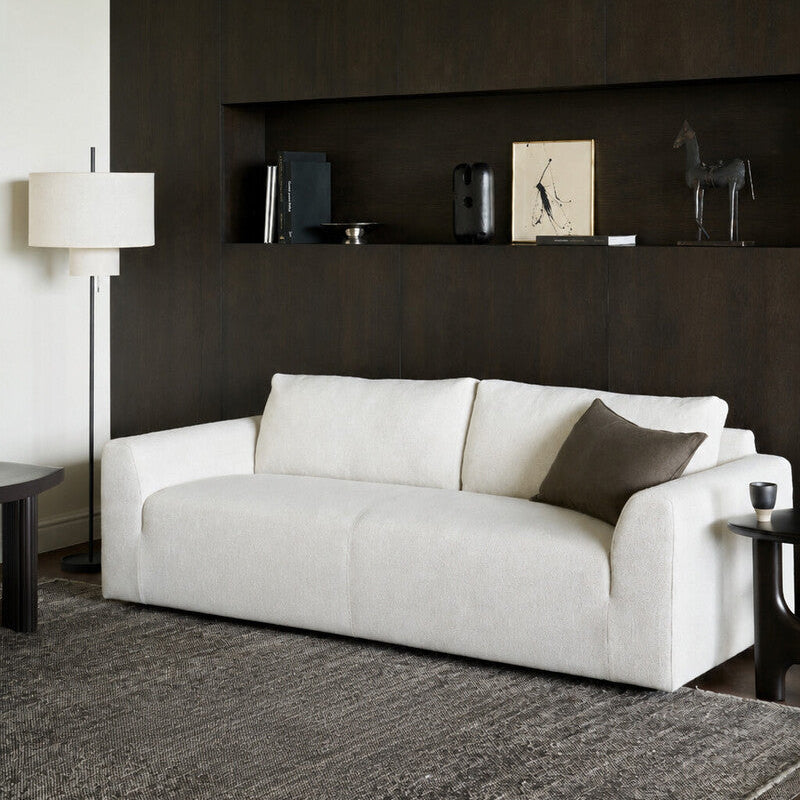




Non-toxic furniture is furniture made and finished to limit the chemicals of concern most associated with home furnishings: added formaldehyde in composite wood, PFAS "forever chemicals" in stain-resistant fabric, and chemical flame retardants in upholstery foam. In the US, regulations like CARB Phase 2 cap formaldehyde emissions and California's TB117-2013 removed the rule that effectively required flame retardants — while certifications such as GREENGUARD Gold and OEKO-TEX verify the rest. At Comosum, we curate brands that document these choices rather than just claim them.
What "Non-Toxic" Actually Means
"Non-toxic furniture" is one of the most-searched phrases in the home category, and also one of the vaguest. No single law defines it, and no piece of furniture is literally chemical-free — everything is made of chemicals. What people usually mean is furniture made without a specific short list of substances linked to indoor air quality and health concerns: added formaldehyde, certain flame retardants, PFAS, and high-VOC finishes.
The useful way to think about it is by source. Most chemical concern in furniture comes from three places: the glues in composite wood, the treatments on fabric, and the foam in cushions. Understanding what's actually regulated — and what a certification does and doesn't promise — turns a scary, open-ended question into a short checklist. The goal of this guide is to be calm and specific rather than alarmist, because the facts are more reassuring, and more actionable, than the marketing on either side suggests.
The Three Chemicals Worth Understanding
Most of the "non-toxic" conversation comes down to three categories. Here's what each one is, and what the rules actually say.
Formaldehyde in Composite Wood
Formaldehyde is used in the adhesives that bind particleboard, MDF, and plywood, and it can off-gas from finished furniture. Since 2018, the US has enforced TSCA Title VI, which adopted California's CARB Phase 2 emission limits nationwide: roughly 0.05 parts per million for hardwood plywood, 0.09 ppm for particleboard, and 0.11 ppm for MDF. The simplest way to sidestep the issue entirely is solid wood or solid bamboo, which contains no composite-board adhesive at all. When composite board is used, look for "no added formaldehyde" (NAF) or ULEF (ultra-low-emitting formaldehyde) certification. It's also worth noting that emissions fall over time: most off-gassing happens early in a piece's life, and airing out a new item in a ventilated room for a few days measurably reduces what reaches your indoor air.
PFAS in Stain-Resistant Fabric
PFAS — per- and polyfluoroalkyl substances, the so-called "forever chemicals" — have historically been used in stain- and water-repellent treatments on upholstery, the kind marketed under names like older Scotchgard formulations. They're persistent in the environment and increasingly restricted. The practical signal to look for is a brand that states its fabrics are PFAS-free, or textiles certified to OEKO-TEX Standard 100, which tests for a long list of regulated substances. Performance weaves can be durable and family-friendly without fluorinated chemistry.
Flame Retardants and TB117-2013
For decades, California's Technical Bulletin 117 effectively pushed manufacturers to add chemical flame retardants to upholstery foam to pass an open-flame test. In 2013, the state replaced it with TB117-2013, a smolder-resistance standard that furniture can meet through fabric construction without added flame-retardant chemicals. Most reputable brands now label their upholstery "contains no added flame retardants." It's one of the clearest examples of a regulation changing for the better.
How Comosum Approaches Non-Toxic Furniture
We can't certify chemistry ourselves, so we do the next best thing: we favor brands that document their material choices and carry independent certifications. That starts with material honesty. Solid wood and solid bamboo avoid composite-board formaldehyde by construction, which is why so much of our bedroom furniture and case goods are solid-wood pieces rather than veneered particleboard.
For the categories where chemistry matters most — upholstery and office seating — we lean on third-party labels. GREENGUARD Gold certifies low chemical emissions and is calibrated for sensitive environments like schools and children's rooms; the Living Building Challenge's Red List names the worst-in-class substances to avoid. Brands like Humanscale and Greenington build their products around exactly these standards. For more on the certification side, see our explainer on what GREENGUARD Gold certification means and our sustainability page.
What to Shop at Comosum
A few pieces that put the principles above into practice, all in stock:
- Greenington Currant Platform Bed — Built from solid Moso bamboo rather than formaldehyde-bonded composite board, so there's no added-formaldehyde concern in the bedroom. From $2,089.
- Greenington Ventura Platform Bed — Handcrafted from 100% solid bamboo, a rapidly renewable grass, with a clean low-VOC finish. From $2,349.
- Humanscale World LM Task Chair — A minimalist Niels Diffrient task chair certified GREENGUARD Gold for low chemical emissions. $545.
- Humanscale Path Task Chair — Designed under the Living Product Challenge, made with recycled ocean-bound plastic and built to Red List-aware standards. From $1,277.
- Humanscale Freedom Ocean Headrest Chair — A GREENGUARD Gold executive chair from one of the most rigorously certified seating lines we carry. From $1,939.
Browse our bedroom furniture and sofas and sectionals, and explore all of our sustainable furniture brands at Comosum →
For related reading, see our guides to building a non-toxic, FSC-certified bedroom and GREENGUARD-certified nursery and kids' furniture.
Frequently Asked Questions About Non-Toxic Furniture
What does "non-toxic furniture" actually mean?
There's no legal definition, but in practice it means furniture made without a short list of substances linked to indoor air quality and health concerns: added formaldehyde in composite wood, PFAS in stain-resistant fabric, chemical flame retardants in foam, and high-VOC finishes. Solid wood, PFAS-free textiles, and third-party certifications are the clearest signals.
Is formaldehyde in furniture dangerous?
Formaldehyde can off-gas from the adhesives in composite wood like particleboard and MDF. Since 2018, US law (TSCA Title VI, mirroring California's CARB Phase 2) caps those emissions at low levels — around 0.05 ppm for hardwood plywood and 0.09 ppm for particleboard. Choosing solid wood or solid bamboo avoids composite-board formaldehyde entirely.
How do I avoid PFAS in furniture?
Look for upholstery a brand explicitly labels PFAS-free, or fabrics certified to OEKO-TEX Standard 100, which screens for regulated substances. Many durable, family-friendly performance fabrics are now made without the fluorinated "forever chemicals" once common in stain-repellent treatments.
Do sofas still contain flame retardants?
Often no. California's TB117-2013 standard, adopted in 2013, lets upholstered furniture pass flammability requirements through a smolder test rather than added chemical flame retardants. Many brands now label their pieces "contains no added flame retardants," but it's worth confirming on the specific product.
Which certifications prove furniture is non-toxic?
GREENGUARD Gold (low chemical emissions, calibrated for schools and children's spaces) and OEKO-TEX Standard 100 (regulated substances in textiles) are two of the most useful. The Living Building Challenge Red List identifies worst-in-class substances to avoid, and a brand designing against it signals serious material screening.
Non-toxic furniture isn't about fear — it's about knowing which questions to ask and which labels to trust. Start with solid materials and verified certifications, and the rest of the worry takes care of itself. See our GREENGUARD Gold explainer for the next layer.
This article is general information, not health advice; if you have specific medical sensitivities, consult a qualified professional about your home environment.




Leave a comment
This site is protected by hCaptcha and the hCaptcha Privacy Policy and Terms of Service apply.