












FSC certification, short for Forest Stewardship Council, is the most widely recognized independent forest-management standard in the world. Founded in 1993 in Toronto and now headquartered in Bonn, Germany, FSC certifies that wood, paper, and other forest products come from forests audited annually for biodiversity, indigenous and worker rights, and full chain-of-custody from log to finished piece. For furniture buyers, an FSC label on a dining table or a bed is the single clearest signal that the timber was sourced responsibly. Every wood-based brand we carry at Comosum is FSC-certified.
The Story Behind FSC
FSC was founded in October 1993 by a coalition of environmental NGOs, foresters, social-rights groups, and progressive timber companies who had walked out of the failed 1992 Rio Earth Summit forest negotiations frustrated that governments could not agree on a binding global forestry standard. Rather than wait for another decade of inter-governmental talks, they built a voluntary, market-driven certification system designed to reward responsible producers and let consumers tell them apart from extractive ones.
The founding meeting was held in Toronto. Within four years FSC had its headquarters in Bonn, a board structured around three balanced chambers — environmental, social, and economic — and a published set of ten core principles that still anchor the standard today. Those principles cover compliance with local law, indigenous and worker rights, biodiversity protection, long-term management planning, and monitoring of forest impact.
Three decades on, FSC certifies hundreds of millions of acres of forest across more than 80 countries, from family-run woodlots in Sweden to large concessions in Canada and the Congo Basin. The Forest Stewardship Council remains the only forest-certification body whose governance gives environmental and social NGOs equal voting weight to industry — a structural detail that is unusual in any industry and that explains why most major environmental organizations cite FSC as the credible standard. You can read the full standard at the Forest Stewardship Council US site.
How FSC Certification Actually Works
The Three FSC Labels
When you see an FSC label on a piece of furniture, look for one of three distinct marks. FSC 100% means all the wood in the product comes from FSC-certified forests — the strongest claim. FSC Mix means the product blends FSC-certified material with controlled wood (verified low-risk non-certified content) and is the most common label on furniture, since wood from a single mill often comes from multiple supply lines. FSC Recycled applies to products made entirely from reclaimed or post-consumer wood fiber. All three are legitimate; the difference matters mostly for context, not for credibility.
Chain-of-Custody Auditing
Forest certification is only half the system. The second half is Chain-of-Custody (CoC) certification, which tracks the wood through every step between forest and finished product — sawmill, kiln, joinery, assembly, packaging. Every company in the chain — including the furniture brand and, in some markets, the retailer — must hold an active CoC certificate, and each is audited annually by an independent third party accredited under Assurance Services International. This is why a brand cannot simply claim FSC; the audit trail has to be unbroken, and any link that fails is publicly logged.
How FSC Compares to PEFC
FSC is often discussed alongside PEFC (Programme for the Endorsement of Forest Certification). The two standards share goals but differ structurally. FSC's three-chamber governance gives environmental and social NGOs equal voting power to industry; PEFC operates as an umbrella that endorses national schemes, which critics argue can dilute the standard in regions with weaker forestry oversight. The Sustainable Furnishings Council recognizes both certifications but treats FSC as the stronger signal — a position widely shared across design publications including Dezeen.
Why Comosum Carries FSC-Certified Furniture
We made FSC certification a baseline requirement, not a marketing feature, when we built our sustainable furniture brands roster. The reason is simple: wood is the largest material category in furniture by mass, and the choices a manufacturer makes about timber sourcing have a bigger climate and biodiversity impact than almost any other single decision in production.
Three of the largest wood-furniture brands we carry — Ethnicraft, FDB Møbler, and Greenington — hold FSC chain-of-custody certificates. At Ethnicraft that covers select indoor teak lines, not its oak or mahogany; FDB Møbler pairs FSC sourcing with the Nordic Swan Ecolabel on its Danish beech and oak; Greenington works with FSC-certified Moso bamboo from managed groves in China. None of these brands treats certification as a sticker — each publishes audit results, supplier lists, and chain-of-custody numbers on its corporate site. For more on the wood structures themselves, our guide to solid wood vs. veneer vs. engineered wood covers how those decisions show up in a finished piece.
What to Shop at Comosum
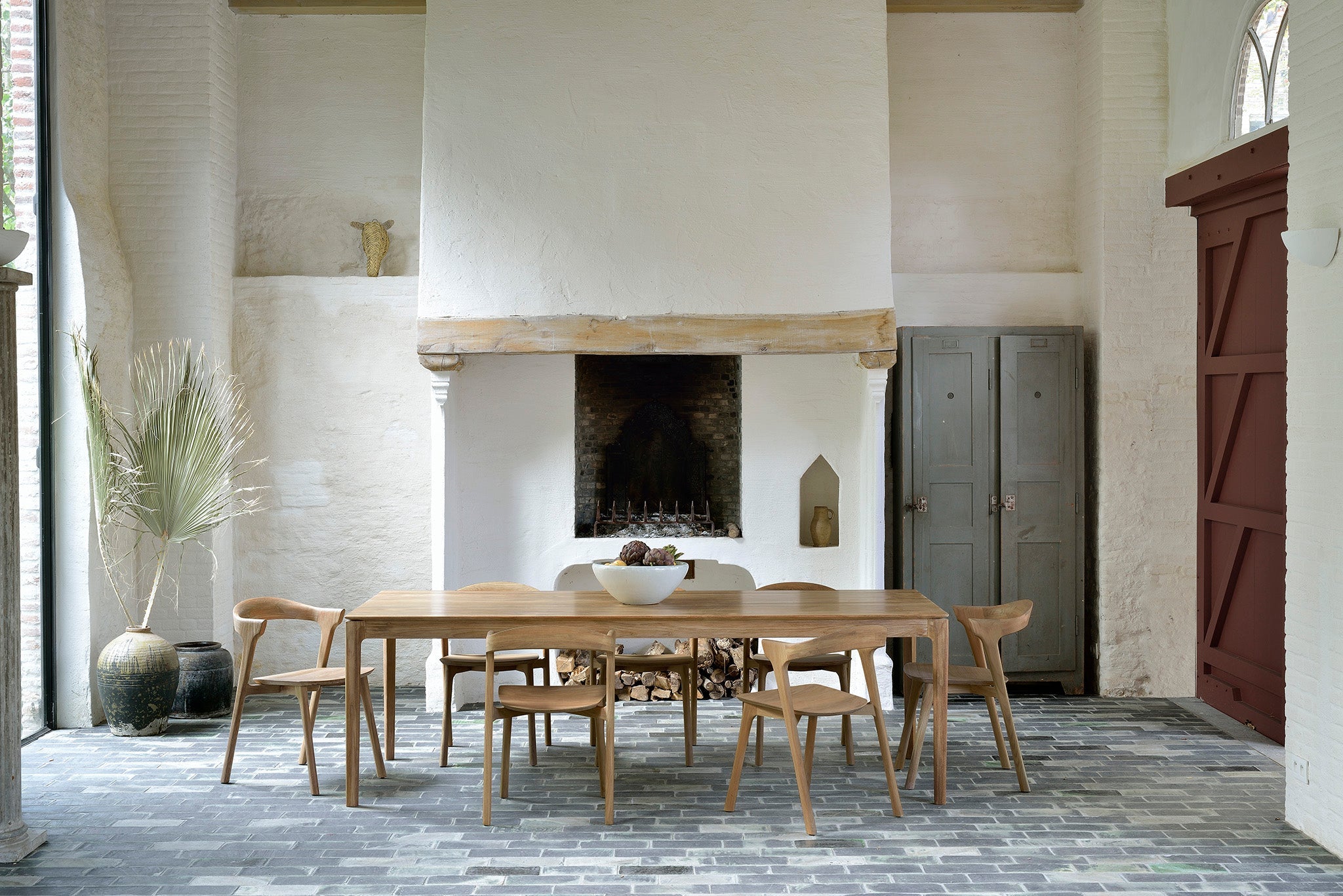
- Ethnicraft Bok Dining Table — Designed by Alain van Havre. Solid oak, or FSC-certified teak, with through-tenon joinery, finished in either oil or water-based varnish. Available in multiple sizes from 55.5″ to 110″ to fit small dining rooms or family-scale spaces.
- Ethnicraft Bok Dining Chair — The companion chair to the Bok table. Solid oak or FSC-certified teak, with an upholstered seat option in leather or no upholstery for a purely wood form. Built to last decades and refinishable.
- FDB Møbler J27 Stool — Designed by Børge Mogensen for FDB's design studio in the 1940s. Solid FSC beech with a water-based natural-lacquer finish and the Nordic Swan Ecolabel — a rare double-certified seating piece.
- Greenington Currant Platform Bed — Solid 100% Moso bamboo from FSC-certified groves on a five- to seven-year regrowth cycle. Available in Amber or Caramelized finish, in Queen, King, and California King.
Browse the full sustainable furniture brands hub at Comosum →, or read our sustainable dining tables buying guide for more on how FSC oak compares to other dining-table materials.
Frequently Asked Questions About FSC Certification
Is FSC really sustainable, or is it greenwashing?
FSC is the certification most environmental NGOs accept as credible because of its three-chamber governance — environmental, social, and economic representatives have equal voting weight, so industry cannot weaken the standard alone. It is not perfect, and the FSC organization itself publishes a public list of suspended and disassociated companies. But independent reviews from groups like Greenpeace and the WWF consistently rate FSC as the strongest mainstream forest-certification system.
What is the difference between FSC 100%, FSC Mix, and FSC Recycled?
FSC 100% means every fiber in the product comes from an FSC-certified forest. FSC Mix combines certified material with controlled wood (verified low-risk non-certified content) and reclaimed fiber — this is the most common label on furniture because most mills handle multiple supply lines. FSC Recycled is made entirely from reclaimed or post-consumer fiber. All three labels indicate independently audited supply chains.
How is FSC different from PEFC?
Both are forest-certification programs, but they are governed differently. FSC has a balanced three-chamber board including environmental and social NGOs; PEFC is an umbrella that endorses national certification schemes, which critics argue can produce uneven standards. Most major design publications and sustainability councils treat FSC as the stronger signal.
Does FSC certification cost the consumer more?
Sometimes, but less than people assume. The audit and chain-of-custody costs are absorbed across the brand's entire output, so the per-piece premium is typically in the low single digits as a percentage of retail price. For a $2,500 solid-wood dining table, that translates to a modest difference relative to the lifetime of the piece — and the resale value of certified furniture tends to hold longer.
How do I verify a brand's FSC claim?
Every FSC-certified company has a unique chain-of-custody license number, usually formatted as "FSC-C######." You can enter that number into the public FSC certificate database to see the brand's certificate status, scope, and audit history. If a brand uses the FSC logo without publishing a number you can verify, treat the claim with healthy skepticism.



Leave a comment
This site is protected by hCaptcha and the hCaptcha Privacy Policy and Terms of Service apply.