

The Nordic Swan Ecolabel is the official environmental label of the Nordic countries, launched in 1989 by the Nordic Council of Ministers and administered by Nordic Ecolabelling. For furniture it operates as product group 031, a lifecycle standard requiring at least 70% certified wood, banning halogenated flame retardants and fluorinated substances, and mandating warranty and spare-parts availability. At Comosum, several FDB Møbler pieces carry it — and almost no American shopper has heard of it.
What Is the Nordic Swan Ecolabel?
Most American furniture buyers can name two certifications. FSC, because it appears on lumber and paper. GREENGUARD, because mattress and office-chair marketing has pushed it hard. The Nordic Swan Ecolabel is arguably stricter than either, and in the United States it is nearly invisible.
The reason is geographic rather than technical. The Nordic Council of Ministers created the label in 1989 as a shared environmental mark for Denmark, Finland, Iceland, Norway and Sweden. It was designed for Nordic consumers and Nordic public procurement, and that is where its recognition still sits. In Denmark, the Swan logo on a chair means something to an ordinary shopper in a way that no American equivalent quite manages. In Ohio it means nothing at all.
Technically, it is a Type I ecolabel under ISO 14024 — the most demanding of the three ISO ecolabel categories. Type I means the criteria are set by an independent third party, cover the full product lifecycle, and require verification by that third party rather than self-declaration by the manufacturer. A brand cannot award itself the Swan. It applies, pays, submits documentation, and is inspected.
What the Furniture Criteria Actually Require
Materials
Under the furniture and fitments criteria (product group 031), wood must be legally harvested and traceable, and a minimum of 70% must come from certified forestry. That threshold is the headline number, but the traceability requirement is arguably the harder part — it forces a manufacturer to document its supply chain rather than simply buy certified stock.
Chemicals
This is where the Swan gets unusually strict. The criteria ban halogenated flame retardants outright. They ban fluorinated substances — the chemistry behind PFAS stain treatments. They ban antibacterial additives including nanoparticles. There are strict limits on substances classified as carcinogenic, toxic to reproduction, or capable of damaging genetic material. Formaldehyde and VOC content and emissions are capped across adhesives, padding, textiles, wood-based panels and laminate.
If you have read our guide to PFAS, formaldehyde and flame retardants in furniture, you will recognise that list. The Swan bans, as a matter of standard, most of what that article warns you to avoid.
Durability and circularity
The criteria also require something most ecolabels skip: proof that the thing works. Products must pass quality and function testing. Manufacturers must provide a warranty, keep spare parts available, and design for material recycling and disassembly. Energy consumption is capped in the production of wood-based panels and laminate, and standby energy is limited on height-adjustable furniture like desks and electric beds.
The current criteria version, 6.0, was adopted on 29 October 2025 and runs until 31 December 2029, with a 6.1 adjustment adopted in March 2026. Criteria are revised on a cycle, which means a licence is not permanent — brands must requalify against tightening requirements.
Why So Few Brands Have It
The Swan is expensive and administratively heavy, and that is deliberate.
As of 1 January 2026, applying for a new furniture licence costs €3,401 excluding VAT, and renewal costs €1,699. On top of that sits an annual licence fee of 0.3% of the certified products' Nordic turnover, with a minimum of €2,267 per year. Manufacturers selling outside the Nordic region pay a fixed €2,267 annually once turnover exceeds €300,000. On-site inspection is included for one visit within the Nordic region; an inspection outside Europe costs €2,834.
Crucially, fees are charged per commodity group. A brand making beds, kitchen fitments, upholstered furniture and general furniture pays four times over.
For a small European manufacturer selling mostly into Nordic markets, that maths works. For a global brand with a catalogue spanning dozens of categories, or an American manufacturer with no Nordic sales at all, it usually does not. The label's absence from a product is therefore weak evidence of anything. Its presence, however, is strong evidence — because nobody pays that much for a logo they could fake with a green leaf graphic and the word "eco."
This is the same reasoning we apply across our certification glossary: a certification's value is a function of how hard it is to get, not how good it sounds.
How It Compares to FSC and GREENGUARD
These labels are often discussed as alternatives. They are not — they measure different things, and the Swan largely contains the others.
FSC certifies forestry and chain of custody. It tells you the wood was responsibly harvested and tracked. It says nothing about the glue, the foam, the fabric or the finish. Our FSC guide covers this in detail.
GREENGUARD Gold certifies indoor-air chemical emissions from the finished product. It tells you the piece will not off-gas above defined thresholds. It says nothing about where the wood came from, whether the product is repairable, or whether it will survive a decade.
Nordic Swan covers forestry sourcing, chemical content, emissions, production energy, quality testing, warranty, spare parts and end-of-life design in one standard. It is broader than either — which is precisely why it costs what it costs.
None of this makes FSC or GREENGUARD weak. It makes them narrower. A GREENGUARD Gold office chair from a brand with no forestry exposure is doing the right test for that product.
Where to Find Nordic Swan Furniture at Comosum
We carry the label mainly through FDB Møbler, the Danish design brand founded in 1942. FDB states on its own accountability page that it is working to bring its full collection under the Swan, and a substantial share of its seating already carries it. Its wood is FSC-certified under chain-of-custody code FSC-C164841, and its textiles carry OEKO-TEX certification.
We flag Swan-certified pieces directly in our product records, so you can see the certification rather than take our word for it:
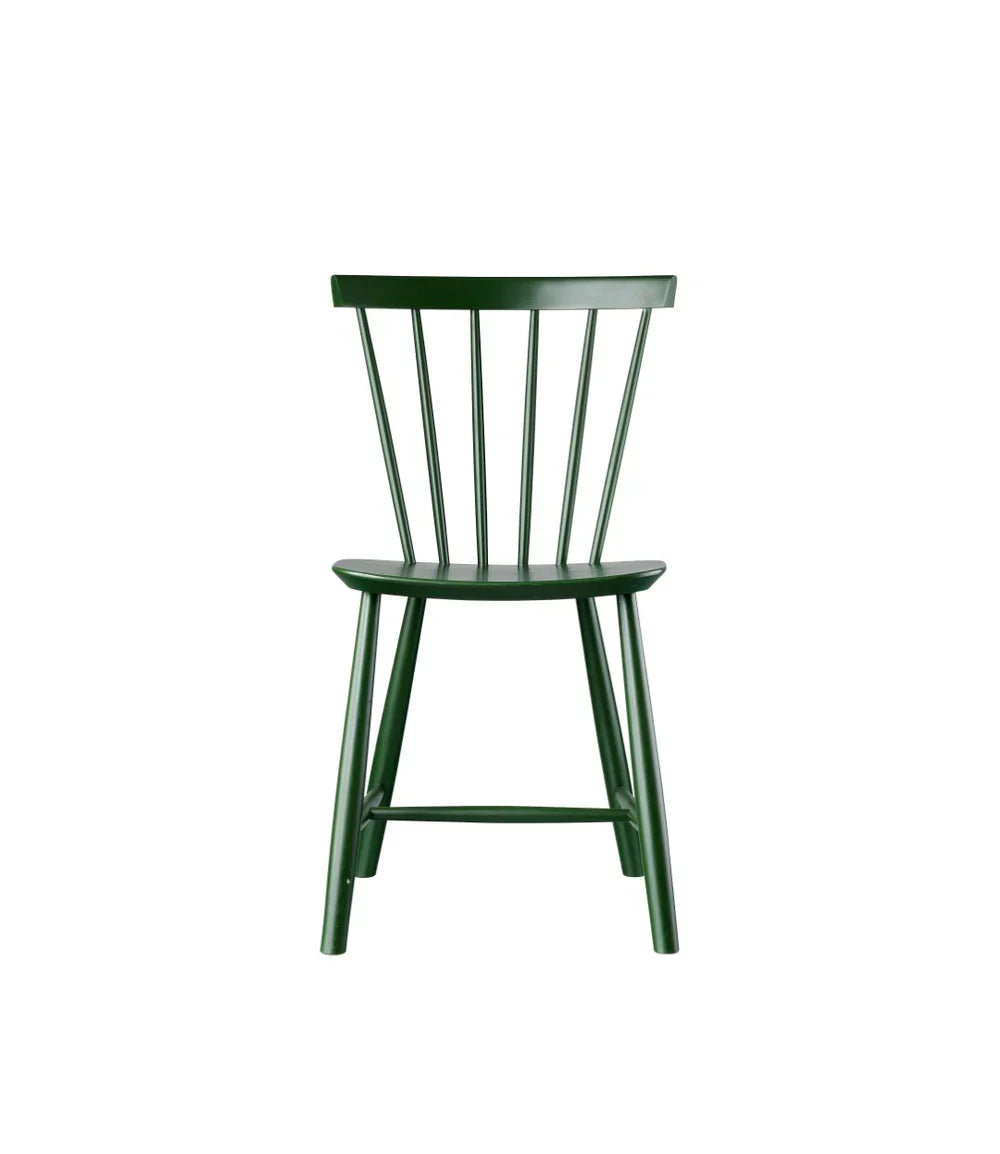
- FDB Møbler J46 Chair — Poul M. Volther, 1956, in solid beech with water-based paint. From $369, and the most affordable Swan-certified chair we stock.
- FDB Møbler J80 Chair — Jørgen Bækmark's spindle-back, jet black beech (RAL 9005). From $869.
- FDB Møbler J27 Stool — a Børge Mogensen design in natural lacquered beech. From $239.
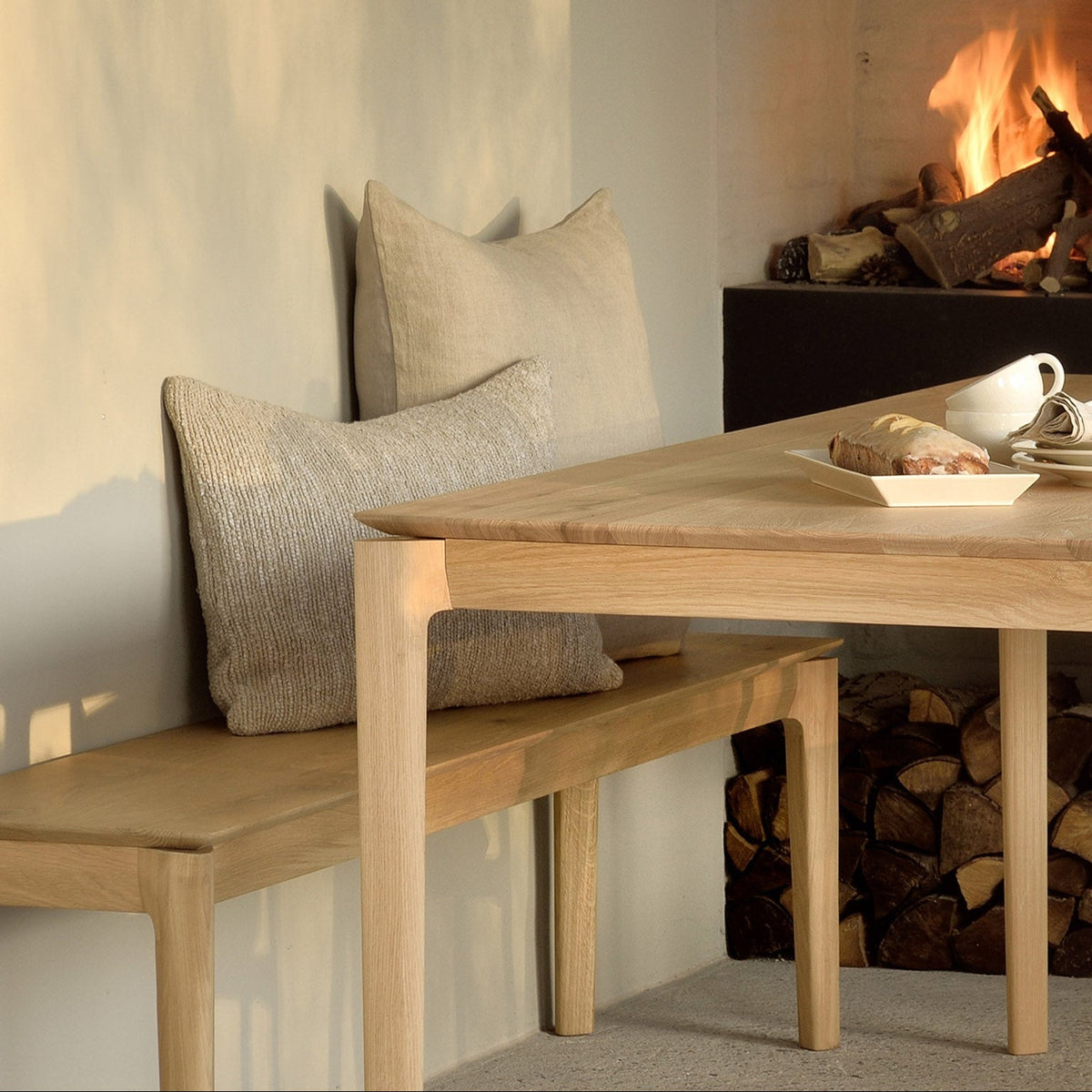
- FDB Møbler J83B Bench — natural solid oak, and a useful way to seat two more without adding two more chairs. From $1,079.
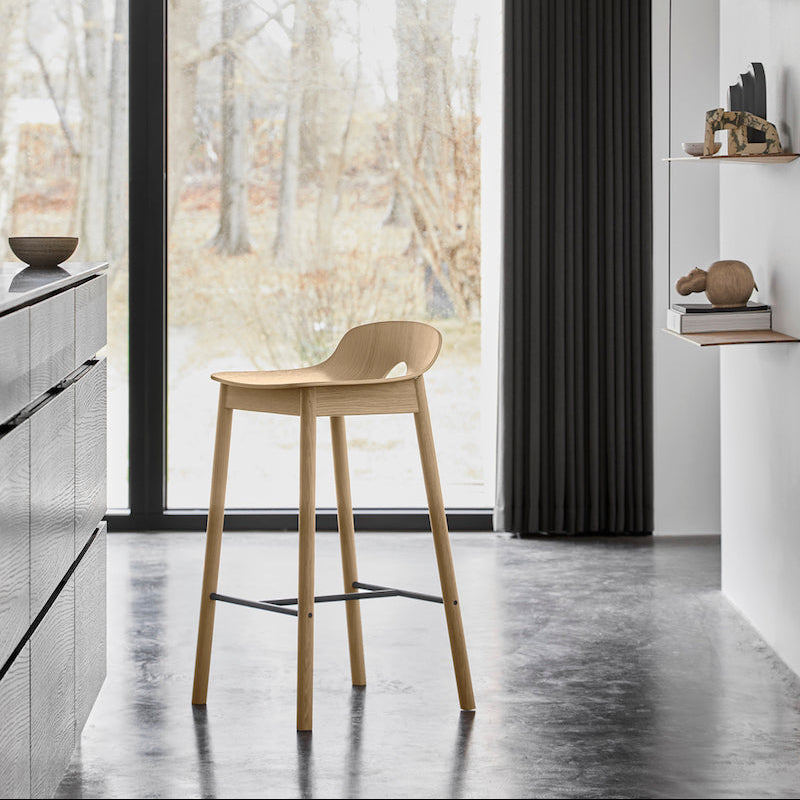
- FDB Møbler J164C Counter Stool — squared solid oak counter height. From $789.
Browse the full FDB Møbler collection, or see how the Swan sits alongside every other certification we track on our sustainable furniture brands page and in our sustainability meter methodology.
Frequently Asked Questions About the Nordic Swan Ecolabel
What is the Nordic Swan Ecolabel?
The Nordic Swan Ecolabel is the official environmental label of the Nordic countries, launched in 1989 by the Nordic Council of Ministers and administered by Nordic Ecolabelling. It is a Type I ecolabel under ISO 14024, meaning criteria are set and verified by an independent third party across a product's full lifecycle.
Is the Nordic Swan Ecolabel stricter than FSC?
They measure different things, but the Swan is broader. FSC certifies that wood was responsibly harvested and tracked through the supply chain. Nordic Swan covers forestry sourcing plus chemical content, emissions limits, production energy, quality testing, warranty, spare-parts availability and design for recycling.
What chemicals does the Nordic Swan Ecolabel ban in furniture?
The furniture criteria ban halogenated flame retardants, fluorinated substances such as PFAS treatments, and antibacterial additives including nanoparticles. They also set strict limits on carcinogenic, reproductive-toxic and mutagenic substances, and cap formaldehyde and VOC content and emissions across adhesives, padding, textiles and wood-based panels.
Why don't more furniture brands have the Nordic Swan Ecolabel?
Cost and geography. A new furniture licence application costs €3,401 as of January 2026, renewal costs €1,699, and there is an annual fee of 0.3% of Nordic turnover with a €2,267 minimum — charged per commodity group. Brands without meaningful Nordic sales rarely find the economics worthwhile, so absence of the label is weak evidence about a product's quality.
Which brands at Comosum carry the Nordic Swan Ecolabel?
FDB Møbler is our primary Nordic Swan brand. A substantial share of its seating — including the J46, J80, J81, J27, J83 and J164C — carries the label, and the company states it is working to bring its full collection under the Swan. We flag certified pieces directly in our product listings.


Leave a comment
This site is protected by hCaptcha and the hCaptcha Privacy Policy and Terms of Service apply.