

Humanscale and Varier answer the same question — how to sit for eight hours without wrecking your back — in opposite ways. Humanscale, founded in New York in 1983, builds chairs that adjust themselves: the Freedom chair, introduced in 1999, uses your body weight instead of levers. Varier, from Norway, builds chairs that make you move. We carry both at Comosum because seating built to be repaired outlasts seating built to be replaced.
Two Philosophies of Sitting
The disagreement between these two brands is older than either company, and it comes down to a single question: should a chair hold you still in a good position, or should it keep you moving?
Humanscale was founded in 1983 by Bob King and is headquartered in New York. Its defining product arrived in 1999, when the late Niels Diffrient — widely described as the father of modern ergonomics — designed the Freedom chair. At the time, task chairs came covered in knobs and levers that most people never touched, which meant most people sat in badly configured chairs. Diffrient's answer was a weight-compensating recline: a self-adjusting mechanism that uses the sitter's own body weight to set recline tension. No dial to get wrong. Sit down, lean back, and the chair does the arithmetic.
Varier's lineage runs through the Norwegian balans movement. In the late 1970s, Hans Christian Mengshoel was studying balanced sitting and coined the term balans, then invited three designers — Oddvin Rykken, Peter Opsvik, and Svein Gusrud — to build furniture around the idea. Their prototypes appeared at the 1979 Scandinavian Furniture Fair in Copenhagen, and in 1984 the four of them received the Jacob Prize, Norway's highest honour for designers and architects.
Peter Opsvik (1939–2024) spent the rest of his career on a single premise: the best posture is the next one. Rather than engineering one correct position, he designed chairs that open up as many comfortable postures as possible and make it easy to shift between them. A Varier chair is not trying to hold you still. It is trying to stop you settling.
How Each Brand Builds Its Chairs
Materials
Humanscale's most instructive product here is the Path task chair. Each Path chair uses 9.49 lbs of ocean plastic — 6.24 lbs from upcycled fishing nets and 3.25 lbs from recycled yogurt cups collected within 50 km of coastlines. Recycled content accounts for more than half of the chair's material composition by weight, and the knit textile developed for it uses recycled yarn equivalent to roughly 68 plastic bottles per chair. That is an unusually specific disclosure for this category, which is precisely why it is worth citing.
Varier works in wood. The Thatsit kneeling chair is built from beech plywood: several veneer layers glued and formed under combined heat and pressure until they hold the chair's curve. It is a low-tech material story compared with reclaimed fishing nets, but it is an honest one — a molded plywood frame has very few parts to fail and nothing bonded shut.
Manufacturing
Varier designs in Norway and manufactures the Thatsit in Poland, keeping production inside Europe and close to its beech supply. Humanscale manufactures across several regions and publishes environmental data at the product level rather than the brand level — a distinction worth understanding, because it means the sustainability claim attaches to a specific chair rather than to a corporate mission statement. You can read the company's own account on its sustainability pages.
Certifications and Recognition
Humanscale is a Certified B Corporation, and the Path chair carries Living Product Challenge certification from the International Living Future Institute — a standard that requires a product to be net positive across multiple impact categories rather than merely less harmful. The Freedom chair, for its part, has been collected by the Cooper Hewitt, Smithsonian Design Museum, which is a different kind of durability credential.
For indoor air quality, the certification to look for on any task chair is GREENGUARD Gold, awarded by UL for low chemical emissions. Varier's design credentials run through the Jacob Prize and the balans lineage rather than through third-party environmental labels — which is worth saying plainly rather than implying otherwise.
Which One Fits Your Desk?
The honest answer depends less on the brands than on how you actually work.
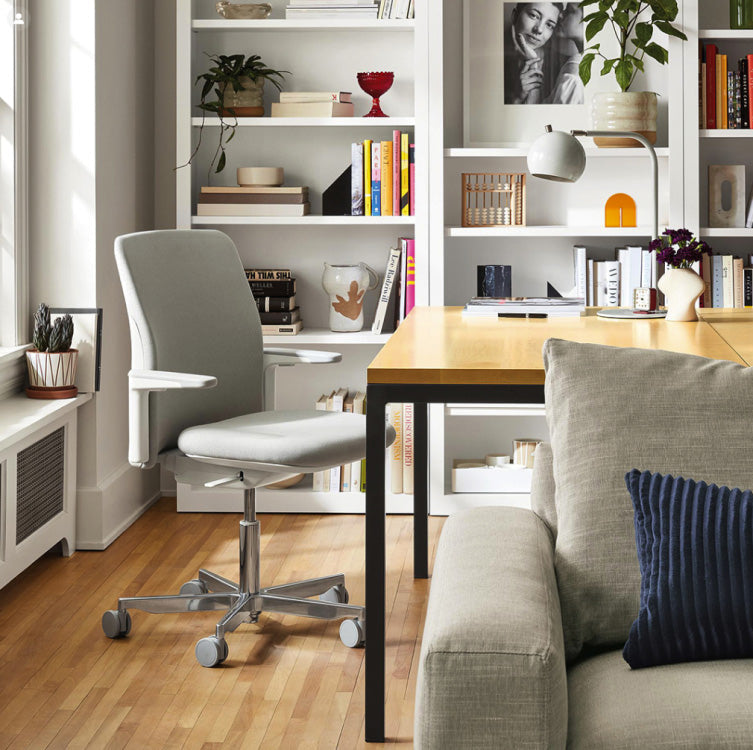
Choose Humanscale if you sit for long, continuous stretches. If your day is four-hour blocks of focused work, you want a chair that supports you without asking anything of you. The weight-sensitive recline means a shared desk works too: two people of different builds get an appropriate chair without touching a single control. Look at the Path or the World LM.
Choose Varier if sitting still is the problem. If you fidget, if your hips ache by mid-afternoon, or if you already alternate between sitting and standing, an active-sitting chair suits the way you move. Varier's Social series works particularly well as a second seat — a chair you rotate into for an hour rather than one you occupy all day.
Consider both. The most comfortable home offices we see are not built around one perfect chair. They are built around two or three seating positions and a desk you can raise. If you are starting from scratch, our sustainable home office setup guide covers the room as a system, and our non-toxic office chair buyer's guide covers what to check on the materials side.
One trade-off to name honestly: active-sitting chairs have a genuine adjustment period. A kneeling chair engages muscles a conventional task chair lets you ignore, and the first week can be tiring. That is the point, but it is not what everyone wants from a Tuesday.
Why We Carry Both at Comosum
We stock both brands because we do not think there is one correct way to sit, and we distrust anyone who says there is. What Humanscale and Varier share is more important than what divides them: both design chairs meant to last decades, both make parts serviceable rather than sealed, and both have kept their signature products in production for a generation instead of restyling them every season.
That matters more than any single feature. A task chair that survives fifteen years and one reupholstery is a better environmental outcome than a chair with an impressive materials story that fails in three. Browse our full office chairs collection and desks, or see every brand we carry on our sustainable furniture brands page.
What to Shop at Comosum
- Humanscale Path Task Chair — The recycled-content flagship: over half its material composition is recycled, including reclaimed ocean plastic. From $1,277.
- Humanscale World LM Task Chair — The most approachable entry into Humanscale's self-adjusting ergonomics, with the same no-knobs philosophy. From $545.
- Humanscale Freedom Ocean Headrest — Niels Diffrient's 1999 design, built in the Ocean materials programme, with the weight-compensating recline that made it famous. From $1,939.
- Varier Social Turn Chair — A swivelling everyday chair from Varier's Social series: light enough to move between desk and table. From $789.
- Varier Ekstrem Lounge Chair — Terje Ekstrøm's sculptural 1984 design, made to be sat in several different ways and still in production four decades on. From $4,999.
- Humanscale Float Micro Desk — A height-adjustable desk that lets you alternate posture, which is what both brands are ultimately arguing for. From $884.
Browse the full Humanscale collection and Varier collection at Comosum →
Frequently Asked Questions About Humanscale and Varier
What is the difference between Humanscale and Varier chairs?
Humanscale designs chairs that adjust themselves to the sitter, using a weight-compensating recline mechanism instead of manual knobs and levers. Varier designs chairs for active sitting, encouraging frequent movement between postures rather than holding one position. Humanscale suits long continuous work sessions; Varier suits people who find sitting still uncomfortable.
Where are Humanscale and Varier chairs made?
Humanscale was founded in 1983 and is headquartered in New York, with manufacturing across several regions and environmental data published at the individual product level. Varier is a Norwegian company; its Thatsit kneeling chair is designed in Norway and manufactured in Poland from molded beech plywood.
Is the Humanscale Path chair actually sustainable?
Path carries Living Product Challenge certification from the International Living Future Institute, and Humanscale publishes specific figures: 9.49 lbs of ocean plastic per chair, of which 6.24 lbs comes from upcycled fishing nets and 3.25 lbs from recycled yogurt cups collected within 50 km of coastlines. Recycled content makes up more than half the chair's material composition by weight.
What is a balans or kneeling chair, and who invented it?
A balans chair distributes weight between the seat and the shins, opening the hip angle and encouraging active posture. The concept was coined by Hans Christian Mengshoel in the late 1970s and developed with designers Oddvin Rykken, Peter Opsvik, and Svein Gusrud, whose prototypes were shown at the 1979 Scandinavian Furniture Fair in Copenhagen.
Which chair is better for back pain?
Neither brand can claim to treat a medical condition, and anyone with persistent back pain should speak to a clinician rather than a furniture retailer. What the research behind both philosophies agrees on is that changing position frequently matters more than any single posture — which is an argument for a supportive primary chair plus a second seating option, or a height-adjustable desk.
Two brands, two answers, one shared conviction: a chair should last long enough to be worth arguing about. Explore both in our office chairs collection.


Leave a comment
This site is protected by hCaptcha and the hCaptcha Privacy Policy and Terms of Service apply.