

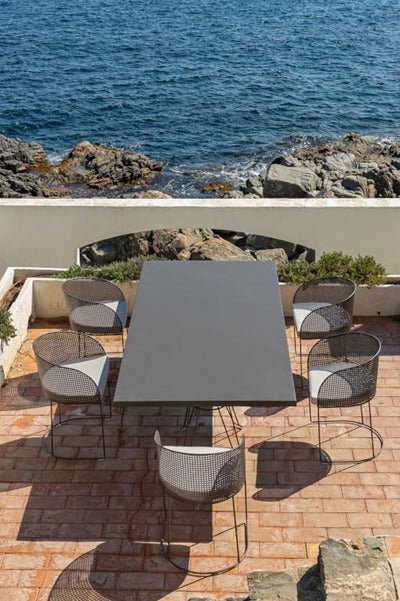
An extendable dining table is the one piece of furniture that has to be two sizes at once: right for a Tuesday dinner for four, and right for twelve people on the last Thursday of November. The best extendable dining tables at Comosum solve that with self-storing leaves in solid oak, bamboo, or Japanese hardwood, built by Ethnicraft, FDB Møbler, Greenington, Case, and CondeHouse. This guide covers the seating math, the three extension mechanisms, and six tables that go from six seats to ten or more without a wobble.
For tables that start smaller, under four feet, see our guide to dining tables for small spaces and the small-space furniture collection.
Why the Extension Mechanism Matters More Than the Length
Most people shop extendable tables by their extended length. That is the wrong first question. A table that seats ten but whose leaves live in a closet gets extended twice a year, then never. The mechanism decides whether the table is actually two tables or just a long one with a chore attached.
There are three ways a table grows, and we carry all three. A Dutch extension stores leaves flat under the top and pulls them out from the ends, the mechanism Poul M. Volther specified for FDB Møbler's C35 series in 1957. A butterfly leaf folds in half and lives beneath the top on a hinge, the approach Greenington uses on the Hudson. External leaves are separate boards you store elsewhere and drop in, which is how Case's Bridge works; it is the least convenient but produces the lightest, cheapest table for a given extended length, because the frame does not carry the leaves' weight every day.
The second question is seating. Designers allow roughly 24 inches of table edge per person, more for armchairs, and about 36 inches of clearance from the table edge to the wall so chairs can pull back. A 63-inch table therefore seats six comfortably; you need about 96 inches for ten. Measure the room extended, not closed. A table that only fits when it is small is a table you will never open.
If you are still choosing between fixed and extendable, our broader sustainable dining tables buyer's guide covers wood, finish, and construction; this post assumes you have decided you need the extra seats.
What Makes an Extendable Table Sustainable
Extension tables have more moving parts, more joints, and more veneer than fixed tables, so the sustainability questions are slightly different.
Materials
Solid wood tops are the simplest case. Ethnicraft's Slice and Double are solid oak with a hardwax oil finish, made in Serbia, and the Double is also offered in untreated solid teak from Indonesia. Greenington's Hudson is 100% solid Moso bamboo, a grass that regrows from its own root system after harvest; Greenington describes its sourcing on its sustainability page. FDB Møbler's C35BH pairs a nature-lacquered oak veneer top with a solid frame in FSC (Forest Stewardship Council)-certified oak; FSC is the third-party chain-of-custody standard we look for on any European oak. Veneer is not a compromise on an extension table: a veneered top over a stable core moves less with humidity than a wide solid board, which is why the leaves on CondeHouse's MOM and Case's Bridge still meet flush after years of seasonal cycles. For fixed and extendable designs in oak only, see our oak dining tables.
Manufacturing
Where a table is made tells you a lot about how it is made. FDB Møbler is a Danish design studio with roots in 1942 that still publishes its designers' names and dates on every piece. CondeHouse has built at its own factory in Asahikawa, Hokkaido, since 1968, and its MOM tables are edged and legged in solid Japanese hardwood. Case builds Matthew Hilton's Bridge in a Lithuanian factory; Ethnicraft's oak tables come from Serbia. None of these is a nameless container of flat-pack from an unknown source.
Longevity Standards
The honest sustainability metric for a dining table is whether it is still in use in 20 years. Extension hardware is the weak point, so we favor tables where the leaves are stored inside the piece (FDB, Greenington, CondeHouse), where the mechanism can be operated by one person (Ethnicraft's Double extends 79 to 118 inches single-handedly), and where the finish can be renewed at home. Hardwax oil on Ethnicraft's oak can be spot-repaired; lacquer and laminate cannot, but they shrug off wine and crayons for a decade first.
Why We Carry These Tables
Of everything in our dining tables collection, the extendable ones are the hardest to buy well, because a bad mechanism hides in the showroom and shows up at Thanksgiving. Our selection criteria for this category are specific: the leaves must fit flush with no lip, the extended table must not rack when someone leans on a corner, the maker must state where the table is made, and the piece must look complete when closed. Every table below meets all four.
They also cover a wide price band. Case's Bridge starts at $1,900 for a small square that grows to seat six; Ethnicraft's Double tops out near $6,800 for a ten-foot solid oak or teak table. Both belong on this list because both will outlast the room they are put in. Browse the whole range across our sustainable furniture brands, or start with the six below.
Our Recommendations: Six Extendable Tables for Holiday Hosting
FDB Møbler C35BH Dining Table with Dutch Extension ($3,829). Six seats every day at 63 inches, up to ten with the leaves drawn out from under the top. Poul M. Volther's 1957 design, solid FSC-certified oak frame. The best everyday-to-holiday ratio on this list.
Case Bridge Extension Table (from $1,900). Matthew Hilton's arched underframe pushes the legs outward, so ten diners at the large size (63 to 102.4 inches) all get their knees under. External leaves; plan a closet shelf.
Greenington Hudson Extendable Dining Table ($2,489). Two butterfly leaves fold beneath the top, taking it from 78 inches and eight seats to 109 inches and twelve in about a minute. 100% solid Moso bamboo in a Black Walnut finish.
CondeHouse MOM Round Extension Table ($2,590). A round top that grows by nearly twenty inches, with the leaf stored inside the table. Round tables seat one more than the geometry suggests because nobody sits at a corner.
Ethnicraft Slice Extendable Dining Table (from $4,139). Solid oak with a hardwax oil finish, made in Serbia, in three sizes up to 71 inches closed and 110 inches open. The grain pattern runs uninterrupted across the leaf, which is rarer than it sounds.
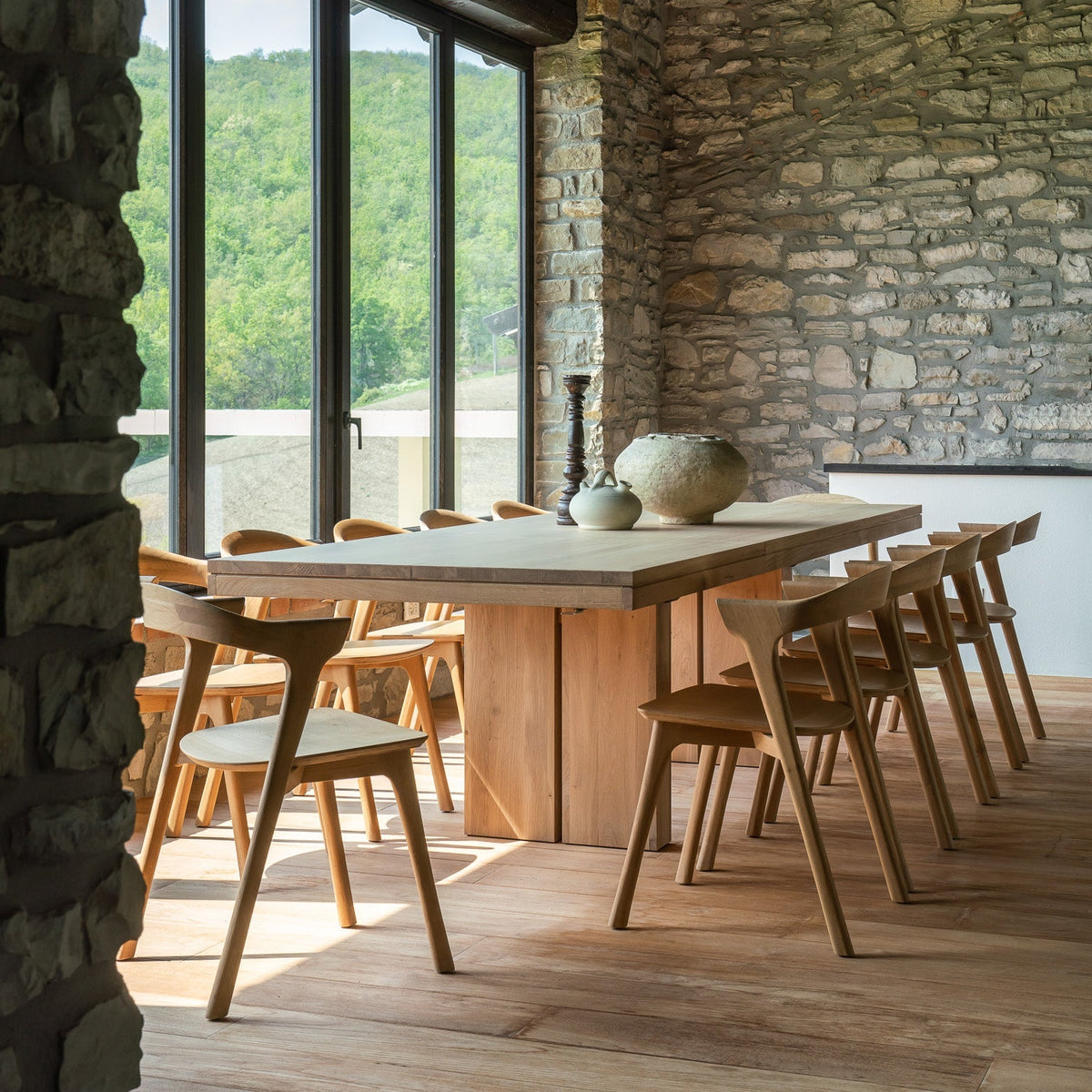
Ethnicraft Double Extendable Dining Table (from $5,999). Eight seats at 79 inches, twelve at 118, and one person can open it in seconds. Solid oak from Serbia or untreated solid teak from Indonesia.
Pair any of them with seating from our dining chairs collection, and browse the full dining tables collection at Comosum →
Frequently Asked Questions About Extendable Dining Tables
How long does a dining table need to be to seat 10?
Allow about 24 inches of table edge per person. Ten people on a rectangular table means roughly 96 to 100 inches of length with four down each side and one at each end, which is why most extendable tables on this list open to between 102 and 118 inches.
Which extension mechanism is the most convenient?
Self-storing mechanisms, meaning Dutch extensions and butterfly leaves, are the most convenient because the leaves stay with the table and one person can open it. External leaves are lighter and cheaper but must be stored elsewhere and carried to the table.
Is a veneered top less durable than solid wood on an extendable table?
Not necessarily. A veneered top over a stable core moves less with seasonal humidity than a wide solid board, so the leaves stay flush over time. Solid oak tops with a hardwax oil finish have the advantage of being spot-repairable at home.
Where are these extendable tables made?
FDB Møbler tables are Danish designs from a design studio founded in 1942; CondeHouse builds in Asahikawa, Hokkaido; Case builds Matthew Hilton's Bridge in Lithuania; Ethnicraft's oak tables are made in Serbia and its teak in Indonesia; Greenington's bamboo tables are built from Moso bamboo.
How much clearance do I need around an extended table?
Plan for about 36 inches between the table edge and any wall or furniture so chairs can pull back and people can walk behind seated guests. Measure your room with the table at its extended length, not its everyday length.


Leave a comment
This site is protected by hCaptcha and the hCaptcha Privacy Policy and Terms of Service apply.