
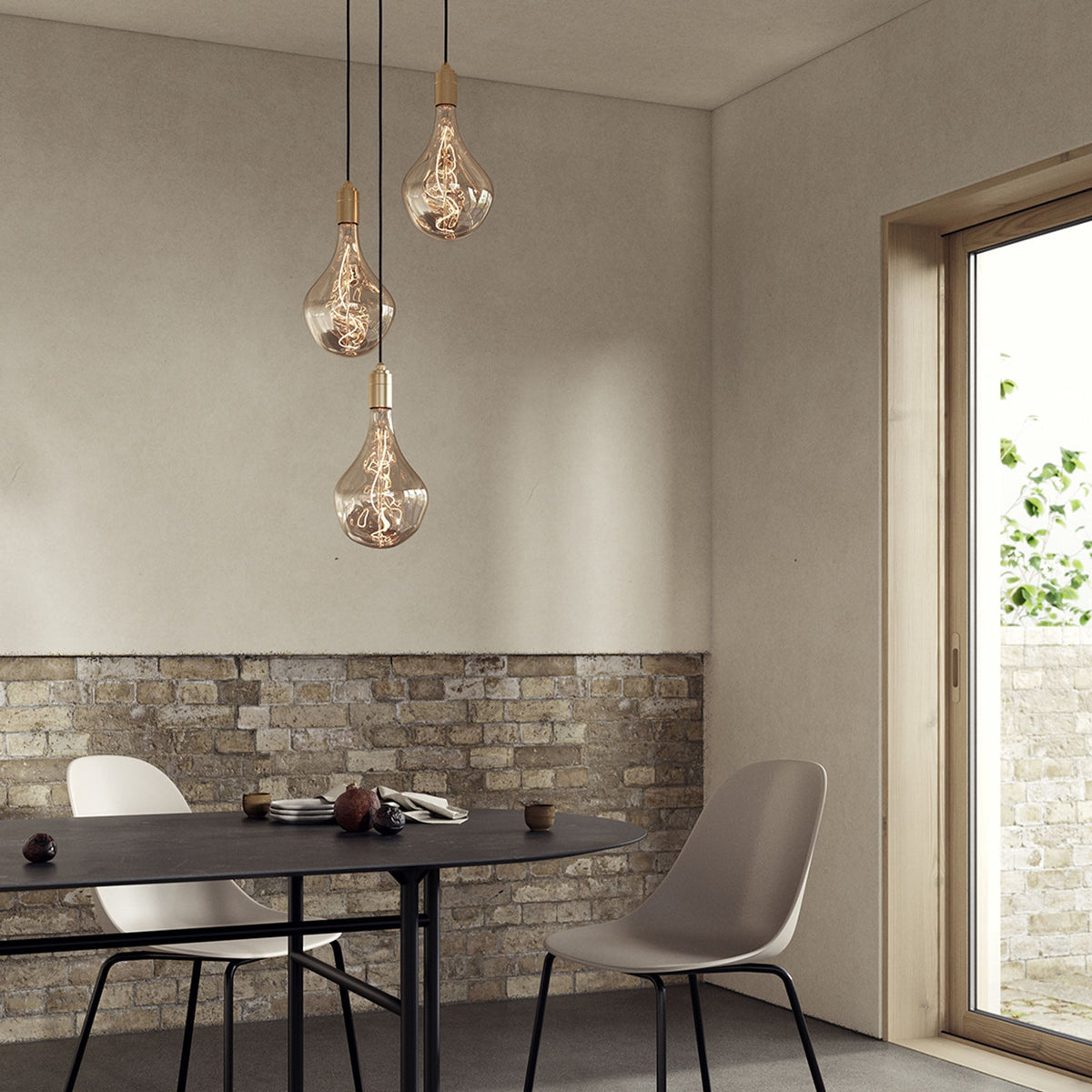
The right pendant over a dining table hangs roughly 30 to 36 inches above the tabletop and measures about one-half to two-thirds the table's width. That is a design rule of thumb, not a code requirement, and it works because it keeps sightlines open and light out of guests' eyes. At Comosum, we favor pendant lights made from durable, repairable materials.
Why Pendant Placement Matters More Than Pendant Style
A dining table is the one surface in a home where people sit still, face each other, and stay for hours. A pendant that hangs too low blocks conversation across the table and puts a bulb at eye level. One that hangs too high turns into a ceiling light and leaves the table in shadow. Scale matters just as much: a small shade over a long table looks lost, and an oversized one crowds the room.
Getting these three variables right (height, diameter, and spacing) is cheaper than replacing a fixture you regret. It also supports our view that lighting should be bought once and kept, which we cover more broadly in our sustainable lighting buying guide.
Height: Where to Hang the Pendant
Measure from the tabletop to the bottom of the shade or bulb. The common range is 30 to 36 inches. Use the lower end for a lower ceiling or a pendant with a solid shade that hides the bulb, and the higher end for an open-bulb design, where glare is more likely. If ceilings are taller than nine feet, plan on lengthening the cord or stem so the fixture stays in that range above the table instead of near the ceiling.
Two practical checks help before you commit. Sit at the table and look across it: you should see the person opposite without the fixture interrupting the view. Then stand and walk around the table to be sure nobody will hit their head when pulling out a chair.
Size: How Wide Should It Be?
A useful guide is a fixture diameter of about one-half to two-thirds the width of the table. For a 36-inch-wide table, that means roughly 18 to 24 inches for a single pendant. This is guidance drawn from common lighting practice, so treat it as a starting point and adjust for the room. A dark, dense shade reads as heavier than an open glass or thin metal one, so you can go slightly larger with airy designs.
Length matters too. For a long rectangular table, one large pendant rarely covers the surface. It is usually better to use several smaller ones or a linear fixture, and let the light run along the table rather than pool in the middle.
Spacing: One, Two, or Three Pendants
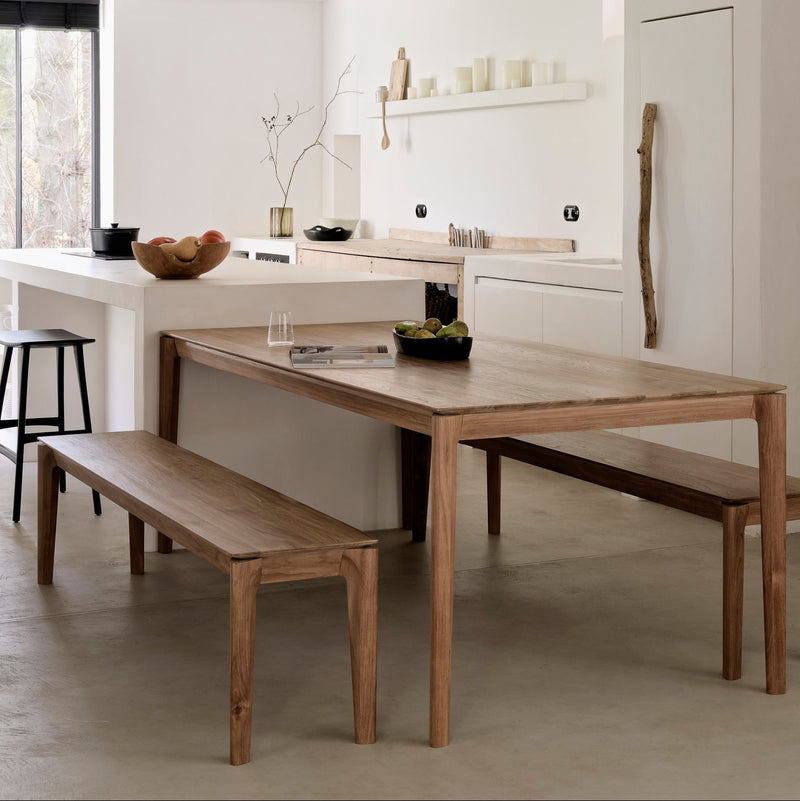
For a round or square table, one centered pendant is the classic answer. For a rectangular table, use two or three pendants centered on the table's length and evenly spaced. As a rule of thumb, keep the outer pendants a few inches inside each end of the table, and leave enough gap between shades that they read as a set, not as a crowd. Keep the whole group narrower than the table itself so nothing overhangs the edge where people sit.
If you are planning around a table that extends for guests, size the lighting for the closed table and check that the fixture still feels balanced when the leaves are in. Our guide to the best sustainable dining tables covers extendable options, and our dining table collection lets you check dimensions before you choose a fixture.
Choosing a Pendant That Lasts
Sustainability in lighting comes down to how long a fixture stays in service and whether it can be repaired. Look for solid materials, replaceable bulbs, and a manufacturer that stands behind its design. Plug-in versions also make renting or relocating easier, since no hardwiring is required. Tala, the London lighting brand, designs its fixtures around efficient LED bulbs; you can read about the brand at tala.co.uk. UMAGE, the Copenhagen design house, builds its lighting to ship efficiently; see umage.com for its design story. For more brands we have vetted, see our list of sustainable furniture brands.
Why We Recommend Getting the Fit Right First
We curate lighting that earns its place, and we would rather help you buy the correct size once than a second time. Pendant lighting is where design and function meet: the shade sets the mood, and the geometry decides whether the room works. If you are unsure, we suggest choosing the table first, then the light, and browsing the wider lighting collection for options that pair with your finishes. Pairing warm-toned bulbs with a wood table tends to flatter both.
What to Shop at Comosum
Every fixture below is currently in the Pendant collection.
- Tala Triple Pendant: three drops from a single canopy, available in brass, graphite, oak, or walnut, suited to a rectangular table.
- Case Solid Pendant: designed by Terence Woodgate around a patented adjustable lampholder, with shades turned from oak, walnut, or marble.
- UMAGE Carmina, Medium: a Danish-made polypropylene shade with a soft wave pattern, designed by Soren Ravn Christensen and Anders Klem.
- Tala Oval II Pendant Light: a single statement pendant for a round or square table.
- Tala Pendant Light: a compact option in graphite, well suited to a small table or a pair.
Browse the full Pendant collection at Comosum.
Frequently Asked Questions About Dining Table Pendants
How high should a pendant hang above a dining table?
Most designers hang a pendant 30 to 36 inches above the tabletop, measured to the bottom of the shade. Choose the lower end for solid shades and low ceilings, and the higher end for open bulbs or tall rooms.
How big should a pendant light be over a dining table?
A good guide is a diameter of about one-half to two-thirds the table's width. For a 36-inch-wide table, that is roughly 18 to 24 inches for a single pendant.
How many pendants should hang over a rectangular dining table?
Two or three pendants, evenly spaced along the table's length, usually look best. Keep the group narrower than the table and the outer pendants a few inches inside each end.
Can I use a plug-in pendant over a dining table?
Yes. Plug-in pendants use a cord and a ceiling hook instead of hardwiring, which suits renters and anyone who may move the table. Position the outlet and cord so the wire does not cross a walkway.
What bulb color works best over a dining table?
Warm white bulbs are the usual choice for dining, since they flatter wood and food alike. A dimmer lets you move from bright for homework to low for dinner.


Leave a comment
This site is protected by hCaptcha and the hCaptcha Privacy Policy and Terms of Service apply.