



What makes a bar stool or counter stool sustainable?
Sustainable, eco-friendly, eco-conscious: the word on the box proves nothing. Four things do.
A material you can trace
FSC-certified solid wood, recycled plastic, or a composite made from waste.
A maker you can check
A named country of make, and company certificates such as B Corp or ISO 14001.
Built for daily use
A strength test, spare parts or a long warranty is the evidence it will last.
Comes apart at the end
One material, or parts that unscrew, can be recycled. Bonded mixed materials rarely are.
Which wood bar stools are FSC-certified?
FSC tells you the wood came from responsibly managed forests. It says nothing about glue or finish, so check those too.
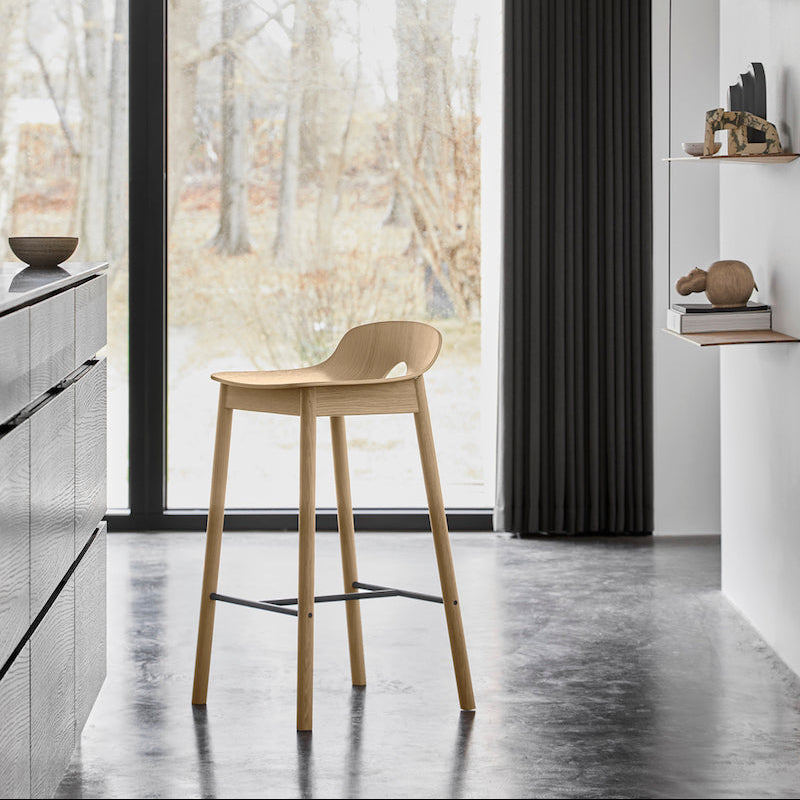
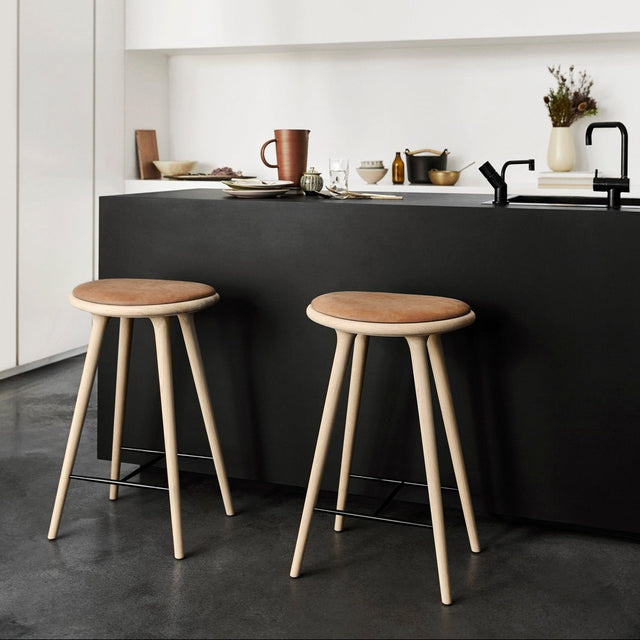
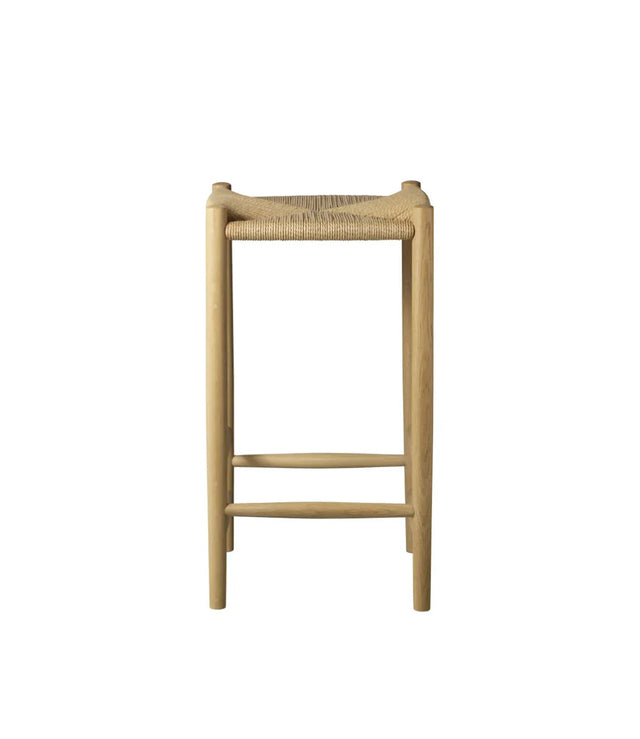
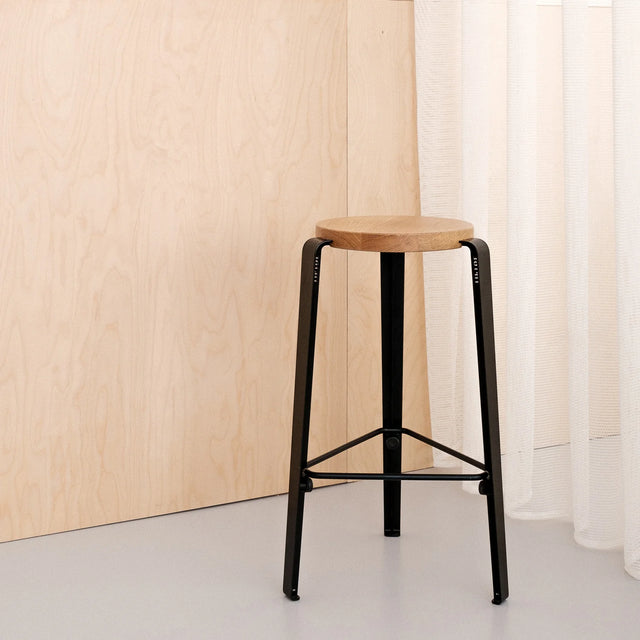
The Mater High Stool, designed by Space Copenhagen, is FSC-certified solid oak or beech with a leather seat, made in Slovenia. Tiptoe’s LOU sets a PEFC/FSC-certified oak seat on steel legs. FDB Møbler holds an FSC chain-of-custody license (FSC-C164841), and its J164C counter stool by Jørgen Bækmark and J27B bar stool by Børge Mogensen carry the Nordic Swan Ecolabel, which also limits formaldehyde and VOCs in glues and finishes.
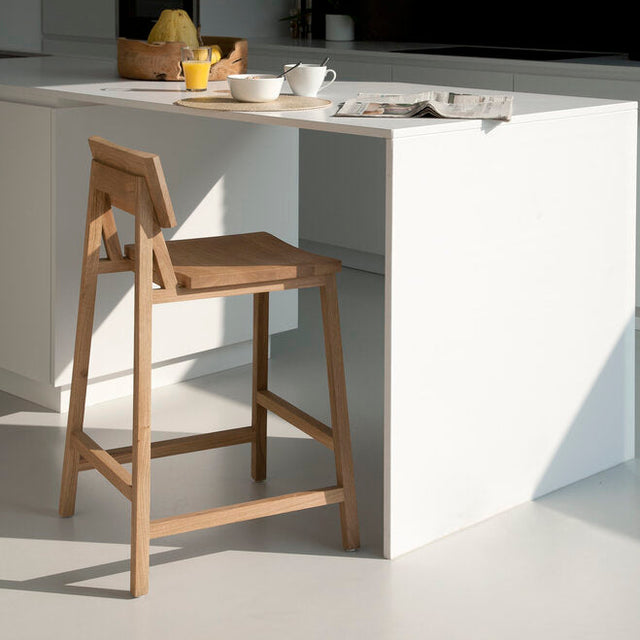
Ethnicraft’s N3 and N4, by Nathan Yong, are solid oak from its Serbian site, which runs on wood-residue energy.

 Mater · Meter 3.8High StoolFSC-certified oak or beech, leather seat; made in Slovenia
From $1,454Shop →
Mater · Meter 3.8High StoolFSC-certified oak or beech, leather seat; made in Slovenia
From $1,454Shop →
 Ethnicraft · Meter 3.5N3 Counter StoolSolid oak, hardwax oil; Nathan Yong design, made in Serbia
$499Shop →
Ethnicraft · Meter 3.5N3 Counter StoolSolid oak, hardwax oil; Nathan Yong design, made in Serbia
$499Shop →
 Ethnicraft · Meter 3.5N4 Bar StoolSolid varnished oak at a 31-inch seat; made in Serbia
$749Shop →
Ethnicraft · Meter 3.5N4 Bar StoolSolid varnished oak at a 31-inch seat; made in Serbia
$749Shop →
 FDB Møbler · Meter 3.7J164C Counter squaredOak and paper cord by Jørgen Bækmark; Nordic Swan Ecolabel
$789Shop →
FDB Møbler · Meter 3.7J164C Counter squaredOak and paper cord by Jørgen Bækmark; Nordic Swan Ecolabel
$789Shop →
 FDB Møbler · Meter 3.7J27B Bar stool - Jet BlackMogensen’s beech stool at bar height; Nordic Swan Ecolabel
$459Shop →
FDB Møbler · Meter 3.7J27B Bar stool - Jet BlackMogensen’s beech stool at bar height; Nordic Swan Ecolabel
$459Shop →
 Tiptoe · Meter 3.8Tiptoe LOU Bar StoolPEFC/FSC oak seat on steel legs that unscrew to recycle
$510Shop →
Tiptoe · Meter 3.8Tiptoe LOU Bar StoolPEFC/FSC oak seat on steel legs that unscrew to recycle
$510Shop →
Which bar stools use recycled plastic or waste?
Recycled plastic and waste composites wipe clean and need no oiling.
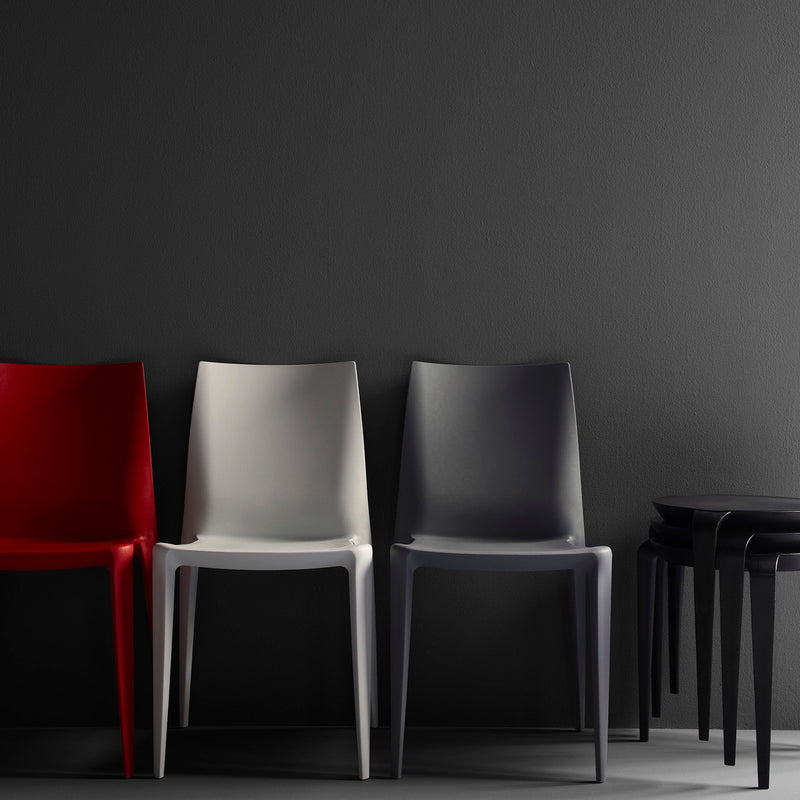
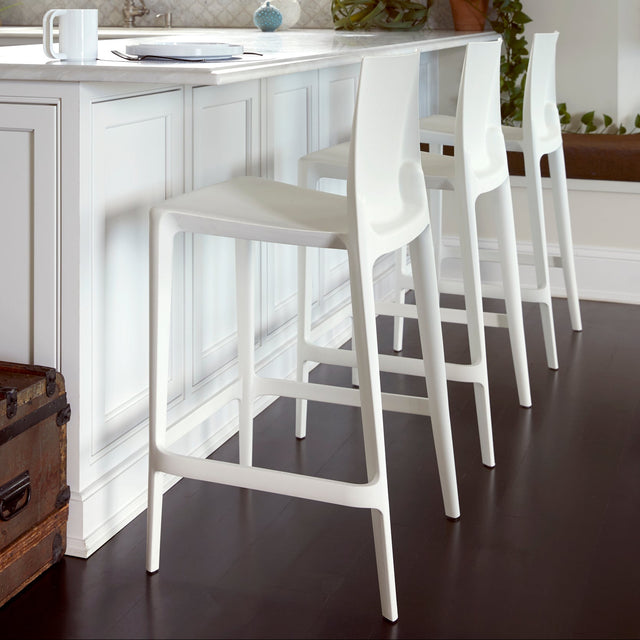
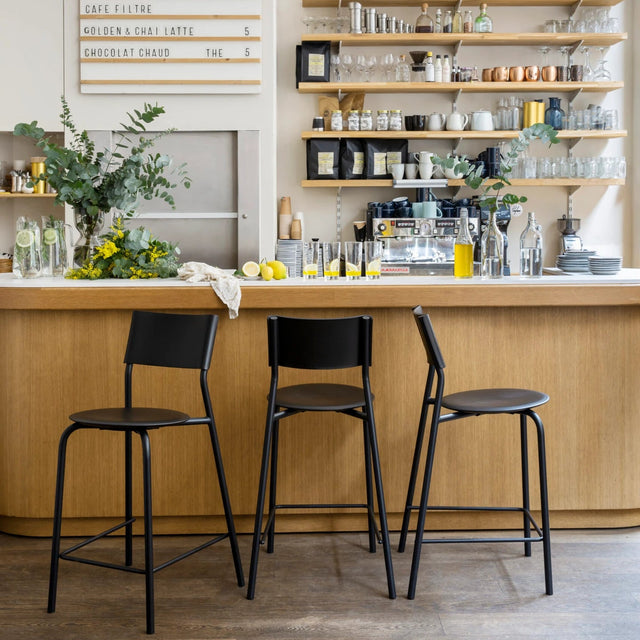
Heller’s Bellini Counter Stool, by Mario and Claudio Bellini, is one molded piece of recycled, fiberglass-reinforced polypropylene, made in the USA. Tiptoe’s SSDr has a recycled-plastic shell that unscrews from its steel frame for recycling. Mater’s Earth Stool, by Eva Harlou, has a seat pressed from Matek: coffee-shell waste from the roaster BKI, bound with recycled plastic.
 Heller · Meter 3.7The Bellini Counter Stool (Set of 2)One piece of recycled polypropylene, made in the USA
$680
Heller · Meter 3.7The Bellini Counter Stool (Set of 2)One piece of recycled polypropylene, made in the USA
$680 Tiptoe · Meter 3.8Tiptoe SSDr Recycled Plastic Bar Chair 29.5inRecycled plastic shell that separates from the steel frame
$630Shop →
Tiptoe · Meter 3.8Tiptoe SSDr Recycled Plastic Bar Chair 29.5inRecycled plastic shell that separates from the steel frame
$630Shop →
 Mater · Meter 3.8Earth StoolSeat pressed from coffee-shell waste and recycled plastic
$519Shop →
Mater · Meter 3.8Earth StoolSeat pressed from coffee-shell waste and recycled plastic
$519Shop →
Which bar stools are low-VOC and non-toxic?
No stool is chemical-free. Low emissions start with few sources: no foam, no particleboard, and solid wood under a water-based lacquer or oil, or a single molded shell.
Here, the Nordic Swan Ecolabel on FDB Møbler’s J164C and J27B is the product label with chemical limits. If you need an emissions certificate, ask for GREENGUARD Gold or an ANSI/BIFMA M7.1 test (VOC and aldehyde emissions measured in a chamber) for the exact model.
The safest bar stool is also stable: a footrest and a strength test such as ANSI/BIFMA X5.1, which covers stools, or EN 16139. Our non-toxic furniture guide covers the rest of the home.
Can a bar stool be LEED, ISO or FSC certified?
Only some of these labels certify a stool at all:
| Label | What it certifies | What to ask for |
|---|---|---|
| LEED | A building or interior project, not a product. A stool can count toward a project’s low-emitting materials credit with emissions data | An ANSI/BIFMA M7.1 report or GREENGUARD certificate for the model |
| ISO 14001 | A company’s environmental management system, audited by an independent body | The certificate, and which site it covers |
| FSC | Where the wood came from, through a chain of custody | The license code (FSC-C…) or the label on the product |
| B Corp | The whole company’s social and environmental performance | The company’s B Lab listing |
| ANSI/BIFMA X5.1, EN 16139 | Strength and durability of the seat | The standard and its year |
Resol’s management system, at its own factory in Spain, is certified to ISO 14001 and ISO 14006 (ecodesign). Cane-line says it has held ISO 14001 since 2009. Tiptoe has been a Certified B Corp since 2022.
What is the most sustainable option for outdoor bar stools?
Outdoors, the most sustainable stool is one you won’t replace after a few summers: it won’t rust or rot, and it holds up to sun.
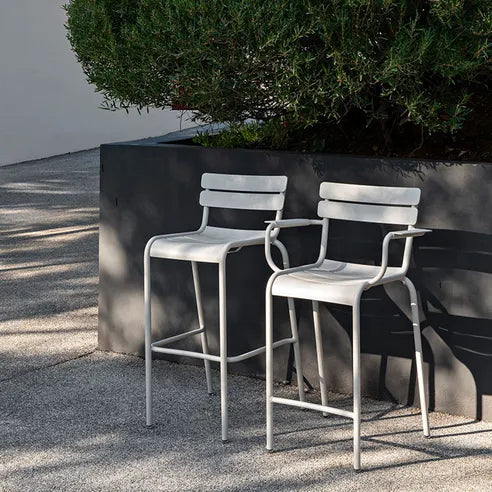
- Aluminum: Fermob’s Luxembourg High Stool, made in France, stacks six high for winter.
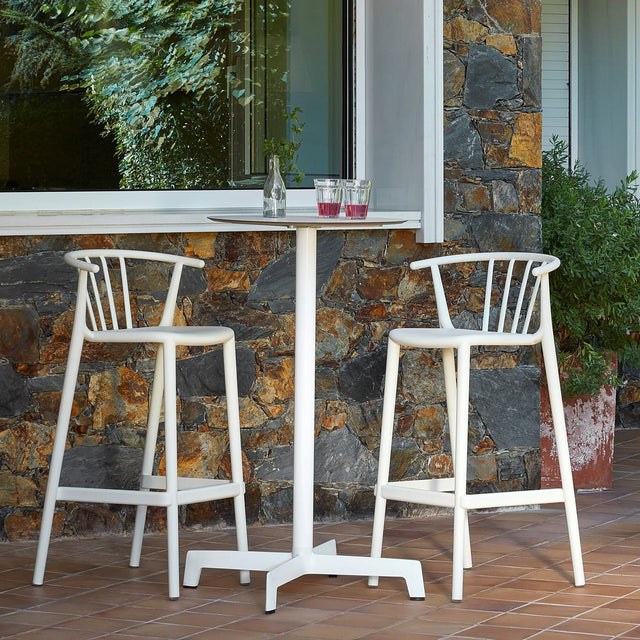
- UV-protected polypropylene: Resol’s Woody is made in-house in Spain and tested to the EN 581 outdoor standards.
- Solid teak: Ethnicraft’s Jack stays out year-round, silvering over time or kept warm with teak oil.
- Weave on aluminum: Cane-line’s Breeze bar chair is UV-resistant weave on aluminum, and it stacks.
Heller’s recycled-polypropylene Bellini Bar Stool works indoors or out. For outdoor wood, see teak vs. acacia vs. aluminum.


 Fermob · Meter 4.0Fermob Luxembourg High Stool (Set of 2)Aluminum, made in Thoissey, France; stacks six high
$1,380Shop →
Fermob · Meter 4.0Fermob Luxembourg High Stool (Set of 2)Aluminum, made in Thoissey, France; stacks six high
$1,380Shop →
 Resol · Meter 3.8Woody Bar Stool (Set of 4)UV-protected polypropylene, made in-house in Spain
$844
Resol · Meter 3.8Woody Bar Stool (Set of 4)UV-protected polypropylene, made in-house in Spain
$844 Ethnicraft · Meter 3.5Jack Outdoor Bar StoolSolid teak frame, bare or with a quick-dry cushion
From $999Shop →
Ethnicraft · Meter 3.5Jack Outdoor Bar StoolSolid teak frame, bare or with a quick-dry cushion
From $999Shop →
 Cane-Line · Meter 3.3Breeze Bar Chair, StackableHand-woven Cane-line Weave on aluminum; stackable
$735Shop →
Cane-Line · Meter 3.3Breeze Bar Chair, StackableHand-woven Cane-line Weave on aluminum; stackable
$735Shop →
 Heller · Meter 3.7The Bellini Bar Stool (Set of 2)Recycled polypropylene; stacks five high, indoors or out
$722
Heller · Meter 3.7The Bellini Bar Stool (Set of 2)Recycled polypropylene; stacks five high, indoors or out
$722Buying bar stools for a cafe, restaurant or small business?
A procurement checklist for commercial bar stools:
- A commercial strength test: ANSI/BIFMA X5.1 or EN 16139, plus EN 581 outdoors.
- Stacking, for cleaning and closing time.
- Spare parts, a written warranty, and stock for the whole run.
- Certificates in writing, for the exact model.
Heller’s Bellini stools are tested to ANSI/BIFMA X5.1 and stack five high; Resol’s Woody is tested to EN 16139 and EN 581; Mater builds the High Stool for residential and commercial use. For multiples, our trade program quotes the whole order with freight and sends the spec sheets and certificates each maker publishes.
What height bar stool do I need for a kitchen island?
| Counter stool | Bar stool | |
|---|---|---|
| Height of the top | About 36 in | About 40 to 45 in |
| Seat heights in this guide | 25.5 to 27.2 in | 29.1 to 31.5 in |
Mater advises about 10 inches between the seat and the underside of the counter.
Every brand we carry is graded on six published categories. How the Sustainability Meter works.


Behind the stool · Tiptoe · Est. 2015 · Paris · Made in Europe
Made in Europe, built to come apart
Matthieu Bourgeaux founded Tiptoe in Paris in 2015. It makes its furniture with around twenty European partners, in powder-coated steel, FSC/PEFC-certified European oak and recycled polypropylene, and designs every piece to ship flat and come apart at the end of its life. The LOU’s oak seat and the SSDr’s recycled shell unscrew from their steel frames, so each material can be recycled on its own. Tiptoe has been a Certified B Corp since October 2022.
- Certified B Corp since October 2022
- Made entirely in Europe
- Designed to flat-pack and disassemble
grade
Questions about sustainable bar stools
Is there a LEED-certified bar stool?
No. LEED certifies buildings and interior projects, not products. A stool can help a project's low-emitting materials credit when the maker supplies emissions data for that model, such as an ANSI/BIFMA M7.1 report or a GREENGUARD certificate.
What does an ISO-certified bar stool manufacturer mean?
An independent body has audited the company's management system: ISO 9001 for quality, ISO 14001 for environmental management. It covers a company and its sites, not a single stool, so ask which factory it covers.
Are FSC-certified bar stools more sustainable?
On one point: the wood. FSC tracks timber from responsibly managed forests to the finished product. It does not cover glue, finish or emissions, so pair it with a water-based lacquer or oil, or a product ecolabel such as the Nordic Swan.
What is the safest bar stool?
One that is stable and low in emissions: the right height, a footrest, a strength test such as ANSI/BIFMA X5.1 or EN 16139, no foam, and a water-based or oil finish or a single molded shell.
Are recycled plastic bar stools durable?
The ones here are built for it. Heller's Bellini stools are fiberglass-reinforced recycled polypropylene tested to ANSI/BIFMA X5.1, and Tiptoe's SSDr shell sits on a powder-coated steel frame. Both wipe clean.